
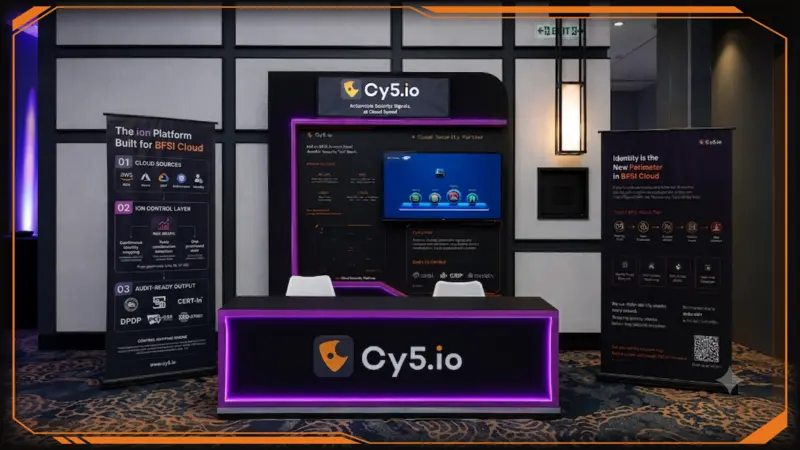

Two days. Hundreds of CISOs. One quiet realisation across the floor – the tools were never the problem.
DSCI FINSEC 2026 wrapped on 29 May at The Westin Powai. Two days of regulator panels, peer roundtables, and the kind of corridor conversations that don’t make it into the agenda. If you spent those two days listening – really listening, past the vendor pitches and the panel theatre – one pattern emerged with uncomfortable clarity.
The Indian BFSI cloud security conversation has shifted. Not in degree. In kind.
For the last five years, every CISO conference in this country has asked variations of the same question: which tools do we need? CSPM or CIEM? Native cloud security or third-party? Build or buy the SOC? FINSEC 2026 wasn’t that conversation.
The CISOs who showed up – running cloud security at scheduled commercial banks, NBFCs, fintechs operating across three or four regulators, payment system operators carrying UPI volumes that would crush most countries’ financial systems – were not asking which tool to buy. They were asking a harder question: why doesn’t any of this work the way the brochures promised?
That’s the conversation worth documenting. Because the answer is also the operating thesis of how cloud security gets done in India over the next eighteen months.
The Cloud Security Paradigm Indian BFSI is Actually Living Through
Here’s the operating reality of a mid-sized Indian bank’s cloud security team in 2026, stripped of euphemism.
You have between three and five cloud accounts.
AWS for the core stack, Azure for the Microsoft estate, GCP because someone in the data team made a decision four years ago.
Each account has hundreds of IAM roles.
Some were created for projects that ended in 2022.
Nobody owns them now. They still have permissions.
You have a CSPM tool that scans your environment every twelve to twenty-four hours. It produces somewhere between four thousand and six thousand findings per cycle. Most are tagged HIGH or CRITICAL. Your team triages perhaps fifteen percent. The rest sit in a queue that grows faster than you can drain it.
You have a SIEM that ingests logs from everywhere. It generates alerts your analysts have stopped reading.
You have a compliance team preparing for the next RBI inspection, the SEBI CSCRF audit cycle that began in FY 2026-27, the DPDP Act enforcement countdown to May 2027, and CERT-In’s six-hour reporting mandate that nobody is quite sure how to operationalise in a cloud-native environment.
And you have a board that asks, every quarter: are we secure? They expect an answer in three slides.
This is the paradigm. Not “we need better tools.” We need a fundamentally different way to think about what cloud security is for a regulated Indian enterprise.
What changed: the architectural shift FINSEC 2026 surfaced
Three conversations dominated the corridors. Each points to the same conclusion.
First: the death of scheduled scanning.
Attackers exploit new misconfigurations in cloud environments within ten minutes on average, per published research from Unit 42 and Mandiant. Traditional CSPM scans every twelve to twenty-four hours. The math is brutal – that’s a 144× detection gap, a window of roughly 1,440 minutes where your cloud is vulnerable and your security stack has no idea. CISOs at FINSEC weren’t debating whether this is acceptable.
They were debating how fast they could move to event-driven architectures that subscribe to live cloud event streams – CloudTrail, Azure Activity Logs, GCP Audit Logs – and detect changes within seconds, not hours.
Second: the collapse of the tool-stack model.
Every BFSI CISO I spoke with operates between eight and twelve security consoles. CSPM in one, SIEM in another, identity governance in a third, compliance reporting in a fourth, cloud-native detection in a fifth. None of them share context. A finding in the CSPM doesn’t connect to the identity in CIEM, which doesn’t connect to the workload in the vulnerability scanner. The attack path that an actual attacker would walk is invisible to any single tool. The CISO has to construct it manually.
At three in the morning. Across browser tabs. The CNAPP category exists to answer this – Cloud-Native Application Protection Platform, unifying CSPM, SIEM, CIEM, KSPM, vulnerability management, and detection into one correlation engine. FINSEC made it clear that CNAPP is no longer optional architecture for Indian BFSI. It’s table stakes.
Third: the multiplication of regulators.
A scheduled commercial bank in India answers to RBI’s Master Direction on Information Technology Governance, SEBI’s Cybersecurity and Cyber Resilience Framework if they have a markets-adjacent arm, IRDAI if there’s an insurance subsidiary, the DPDP Act for any personal data they process, PCI-DSS for cardholder environments, and CERT-In’s six-hour incident reporting mandate as horizontal coverage. Six frameworks. Different evidence formats. Same underlying controls.
The traditional response is to staff each compliance workstream separately. FINSEC’s quieter realisation: that’s no longer financially or operationally viable. The architectural answer is one continuous evidence layer, mapped once across every framework, filtered into whichever report a regulator asks for.
Why most platforms are not built for India
A specific point became impossible to ignore across the two days.
Most cloud security platforms presenting at FINSEC were global products with an India deployment layer bolted on. They have RBI in their compliance dropdown. They map to SEBI CSCRF on a marketing page. The deeper you go, the thinner it gets.
What a regulated Indian enterprise actually needs goes beyond a compliance dropdown:
- Native understanding that the RBI Master Direction on Cyber Security Framework for SCBs is the operating regulation, not a checklist
- Specific clause mapping to SEBI CSCRF‘s 205-page master circular issued 20 August 2024, now in its first full audit cycle
- Continuous monitoring against the DPDP Act 2023 with enforcement effective from 13 May 2027 and penalties up to ₹250 crore per instance for significant data fiduciaries
- Pre-built reporting templates for CERT-In’s six-hour incident reporting under Section 70B of the IT Act
- Engineering teams in Indian time zones for incident response — because when CloudTrail shows an anomaly at 2 AM IST, you don’t want to wait six hours for San Francisco to wake up
The teams building cloud security for India need to live in this regulatory context, not visit it. FINSEC made the distinction visible.
The role Cy5 played at FINSEC 2026
Cy5 was named the Official Cloud Security Partner for DSCI FINSEC 2026 – a positioning the company earned by building exactly the kind of platform the conversations on the floor were demanding.
The ion Cloud Security Platform is engineered around three architectural decisions that map directly to the paradigm shifts FINSEC surfaced.
Event-driven, not scan-based. ion subscribes to live cloud event streams across AWS, Azure, and GCP, evaluating every configuration change the moment it occurs. Detection times measured in 30 seconds to 3 minutes, not 12-24 hours. For CERT-In’s six-hour reporting mandate, this is the only architecturally sound design pattern – you cannot report what you haven’t yet detected.
One correlation engine, six modules. CSPM for posture, CIEM for identity entitlements, KSPM for Kubernetes posture, cloud-native SIEM for event correlation, vulnerability management for exploitability-ranked CVEs, and Luna AI as the natural-language interface across the entire risk graph. The point isn’t that ion has six modules – many platforms claim that. The point is that all six share the same data model, so a finding in posture connects to the identity that touches it, the workload it runs on, and the data it can reach. Toxic combinations become visible. Attack paths render automatically. The CISO doesn’t have to construct them manually.
Built in India, for India’s regulatory context. Native control mapping across RBI Master Direction, SEBI CSCRF, IRDAI cyber guidelines, the DPDP Act 2023, PCI-DSS 4.0, and CERT-In reporting. India-based engineering team. No time-zone roulette during incident response. Compliance evidence packs auto-compiled, reducing audit preparation from months to days.
The platform sits behind verified outcomes from production deployments. Audit preparation cycles compressed from three months to three days at a Mumbai fintech. Alert volume reduced by 96% — from 4,700 unranked findings to roughly 50 prioritised exposures – at multi-cloud telecom workloads in Gurugram. Mean time to detection was reduced from 24 hours to 3 minutes at the same telecom. Zero production exposures over twelve months at a Bengaluru ed-tech deploying 5-10 times daily through ion’s CI/CD integration.
These are not pilot numbers. They are five years of production data from Indian customers, with 100% customer retention from 2022 to 2026.
What this means for Indian BFSI cloud security leaders right now
If you’re a CISO, IT head, or cloud security lead at an Indian bank, NBFC, fintech, insurer, or payment system operator, here is what FINSEC 2026 actually demanded you walk away with.
Stop benchmarking against your existing tool stack. Benchmark against the architecture your regulator’s next audit cycle will demand. The gap between scheduled scanning and event-driven detection is no longer a feature comparison – it’s a compliance posture comparison.
Audit your identity sprawl now, not after the breach. Most BFSI cloud breaches in the last eighteen months started with a legitimate credential and ended with a misconfigured IAM role. No zero-day required. The average Indian BFSI organisation runs 3.5 cloud accounts with hundreds of IAM roles per account — that’s thousands of permissions to track in a system that changes every deployment. CIEM tooling that does this continuously, not annually, is now baseline.
Treat compliance as a continuous evidence layer, not an annual project. SEBI CSCRF is now in its first full audit cycle. DPDP Act enforcement begins in eleven months. The architectural decision to map every control evaluation once, across every applicable framework, then filter into specific regulator reports, is the only way the math works for a team running multiple compliance workstreams in parallel.
Insist on India-grounded vendors. Not Indian-flagged. Indian-grounded. The team that built your cloud security platform should know the specific clause number in the RBI Master Direction that applies when you deploy a new workload in a region outside India. They should know what NPCI’s expectations are around UPI transaction monitoring. They should be available on Indian Standard Time when CloudTrail flags something at 2 AM.
The path forward
DSCI FINSEC 2026 closed with a tone the previous editions did not have. Less performative. More operational. Less “here is the future of cybersecurity” and more “here is what we need to fix by Friday.”
That shift is, in itself, the story. Indian BFSI cloud security has matured past the marketing phase. The CISOs running these environments have lived through enough incidents, enough audit cycles, enough vendor evaluations to know exactly what works and what doesn’t. They are no longer evaluating tools. They are evaluating architectures.
The platforms that win the next eighteen months in Indian BFSI will be the ones built around the operating reality of an Indian CISO – event-driven detection because attackers move in minutes, unified correlation because attack paths don’t respect tool boundaries, and continuous compliance evidence because the regulatory stack does not pause for your annual audit prep.
Cy5 built ion around exactly that operating reality. FINSEC 2026 validated that the market is finally ready to demand it.
Frequently Asked Questions
DSCI FINSEC is the annual financial sector cybersecurity conclave organised by the Data Security Council of India, the not-for-profit industry body for data protection set up under NASSCOM. FINSEC 2026 was held on 28-29 May 2026 at The Westin Powai, Mumbai, bringing together CISOs, security leaders, and regulators from across Indian banking, NBFC, fintech, insurance, and capital markets sectors to discuss the operating challenges facing financial cybersecurity.
FINSEC matters because Indian BFSI operates under one of the world’s most complex regulatory environments — answering simultaneously to RBI, SEBI, IRDAI, DPDP Act, PCI-DSS, and CERT-In — while running cloud-native workloads at a scale that few other countries match. FINSEC is where the operational reality of running cybersecurity inside this constraint gets discussed honestly, away from the marketing layer.
The dominant challenges are identity sprawl across multi-cloud environments, the detection gap between scheduled cloud security scans and the speed of modern attacks, tool sprawl with eight to twelve security consoles per organisation, regulatory multiplication across six frameworks, and the operational impossibility of continuous compliance evidence production using point-in-time tooling.
CNAPP (Cloud-Native Application Protection Platform) is the architectural category that unifies cloud security posture management (CSPM), cloud infrastructure entitlement management (CIEM), Kubernetes security posture management (KSPM), cloud-native SIEM, vulnerability management, and AI-powered analysis into one correlation engine. For BFSI, it matters because attack paths in cloud environments cross all of these domains. Point tools cannot construct the path. A unified CNAPP can.
Compliance with the RBI Master Direction on IT Governance, Risk, Controls and Assurance Practices requires continuous configuration monitoring, data residency validation, encryption and key management controls, audit trail maintenance, and incident reporting capabilities. The architectural answer is event-driven detection mapped natively to RBI clauses, with auto-compiled evidence packs, rather than periodic manual audit preparation.
SEBI CSCRF was issued via circular SEBI/HO/ITD-1/ITD_CSC_EXT/P/CIR/2024/113 dated 20 August 2024, replacing the earlier 2015/2018 cyber security guidelines. The 205-page master document covers 22 entity types across a five-tier classification model. Market Infrastructure Institutions had a January 2025 compliance deadline. Other regulated entities reached final compliance by 31 August 2025. FY 2026-27 is the first full audit cycle.
Event-driven cloud security detects misconfigurations in real-time by subscribing to live cloud event streams — AWS CloudTrail, Azure Activity Logs, GCP Audit Logs and evaluating every configuration change the moment it occurs. Detection times are measured in 30 seconds to 3 minutes. Traditional CSPM uses scheduled scanning every 12-24 hours, creating a 144× detection gap during which attackers can operate undetected. For CERT-In’s six-hour incident reporting mandate, only event-driven architectures provide compliant detection windows.
Cy5 ion is an event-driven CNAPP built specifically for Indian regulated enterprises. The platform discovers and evaluates 100+ cloud resource types across AWS, Azure, and GCP through agentless deployment with read-only IAM. It unifies six security modules – CSPM, SIEM, CIEM, KSPM, vulnerability management, and the Luna AI assistant – through one correlation engine that surfaces toxic combinations and ranks findings by blast radius. Native compliance evidence mapping covers RBI Master Direction, SEBI CSCRF, IRDAI guidelines, the DPDP Act 2023, PCI-DSS 4.0, and CERT-In reporting requirements. Engineering is India-based, with verified production outcomes including 96% alert reduction, audit prep compressed from three months to three days, and 100% customer retention from 2022 to 2026.