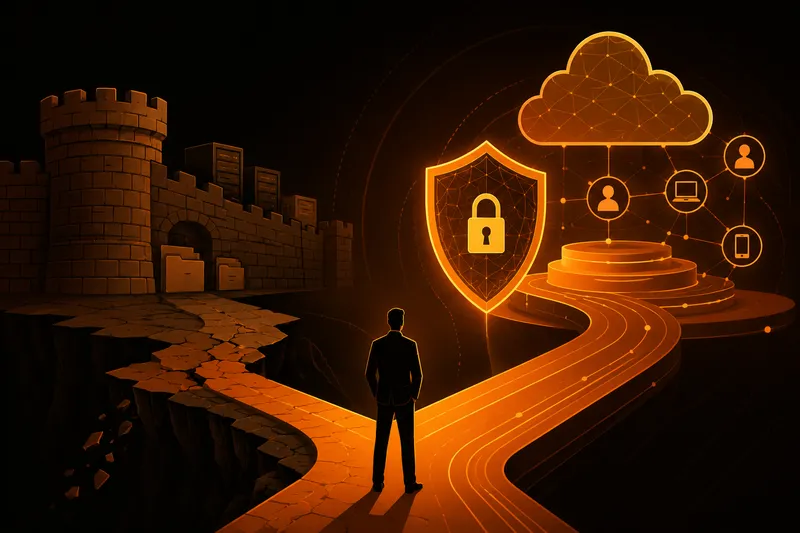

Here is the security architecture Indian enterprises built for the last decade: a fortified perimeter. Firewalls at the network edge. VPNs for remote access. IDS/IPS at ingress points. Everything dangerous is “outside.” Everything inside the perimeter is implicitly trusted.
This model had one fatal assumption: that the perimeter was defensible, and that you could reliably categorize traffic as internal (trusted) or external (untrusted).
Cloud computing detonated that assumption. There is no perimeter when your applications run on AWS in Mumbai, your data lake sits in Azure’s Pune region, your SaaS collaboration tools are managed by third parties in the US, and 67% of your employees are using unsanctioned cloud applications you don’t even know exist.
A January 2025 academic research paper – “Advanced Cloud Security Frameworks: Tackling Evolving Threats and Ensuring Data Integrity” – documents the structural problem facing Indian CISOs: the traditional security model assumed isolated, on-premises systems where data sovereignty was physical, access was controllable, and threats were external. Cloud environments are the precise opposite: data distributed globally across jurisdictions, access from anywhere via the internet, and threats that increasingly originate from inside the network through lateral movement attacks after initial compromise.
The research catalogs 28 distinct threat vectors specific to cloud computing. Lateral movement attacks – where attackers pivot from one compromised resource to another within your cloud environment – rank among the most dangerous, precisely because perimeter-based security cannot detect them. The attacker is already “inside.”
How to Implement Secure Design Principles in Cloud Computing
Building your architecture is only half the battle. See how to bake security into cloud design from the first line of infrastructure — least privilege, secure defaults, and the principles that stop misconfigurations before they ship.
Read the guideFor Indian enterprises operating under the DPDP Rules 2025 (with penalties up to ₹500 crore for personal data breaches) and CERT-In’s July 2025 audit mandates (requiring 24/7 SOC coverage and 180-day encrypted log retention), the question is no longer whether to adopt Zero-Trust Architecture. The question is whether you adopt it before or after your next regulatory investigation.
This article examines what Zero-Trust Architecture actually means in operational terms for multi-cloud environments, why quantum-resistant encryption is the only future-proof cryptographic strategy, and how platforms purpose-built for Zero-Trust principles – like Cy5’s ion Cloud Security Platform – make these frameworks executable rather than aspirational.
Part 1: The Shadow IT Crisis – When 97% of Your Cloud Is Invisible
The Scope Nobody Wants to Acknowledge
Before discussing Zero-Trust implementation, you must confront the foundational problem: you cannot secure what you cannot see, and you cannot see 97% of your cloud estate.
According to 2025 data compiled across multiple industry studies:
- 97% of cloud applications in use within the average Indian enterprise are Shadow IT – deployed without IT approval or security vetting (Beezy Enterprise Cloud Security Report)
- 42% of all company applications result from Shadow IT adoption (Gartner 2025)
- The average organization has 975 unknown cloud services, with IT teams tracking only 108 sanctioned services
- 80% of employees admit to using Shadow IT according to Cisco research
- 65% of all SaaS applications are unsanctioned – used without IT approval
- $135,000 annually is wasted per company on unnecessary SaaS tools
- 83% of organizations have experienced multiple data breaches, with 45% occurring in the cloud
- Gartner predicts one-third of successful cyberattacks will target data stored in Shadow IT infrastructure
Alt-text: “Comprehensive statistics table showing 2025 Shadow IT crisis data – 97% of cloud apps are unsanctioned, 975 unknown cloud services per organization, 83% breach rate with 45% occurring in cloud, and $135K annual waste per company in Indian enterprise multi-cloud environments.”
For Indian enterprises, the Shadow IT problem compounds existing regulatory risk. When an employee uses personal Dropbox to share a spreadsheet containing customer PII, that data has potentially exited India’s territorial jurisdiction (DPDP Act Section 16 data localization requirements), traveled through infrastructure with no security vetting, and created an unencrypted data residency violation, all without IT’s knowledge.
The CERT-In July 2025 framework requires organizations to maintain “comprehensive asset inventory including cloud resources.” When 97% of your cloud resources are Shadow IT, you are structurally non-compliant before a single security control is evaluated.
The Three Failure Modes of Perimeter Security in Cloud
Shadow IT exists because perimeter-based security creates three failure modes that Zero-Trust architectures are designed to eliminate:
Failure Mode 1: Binary Trust Based on Network Location
Traditional security: If the traffic originates from inside the corporate network, it is trusted. If outside, it is untrusted.
Cloud reality: Your “corporate network” is AWS VPCs, Azure Virtual Networks, GCP projects, and SaaS applications hosted anywhere globally. Network location conveys zero information about trust worthiness. An attacker who compromised a developer laptop is “inside” your network the moment they authenticate to AWS.
Failure Mode 2: Implicit Trust After Initial Authentication
Traditional security: Once a user authenticates at the VPN gateway, they are trusted to access any resource inside the perimeter.
Cloud reality: An attacker who steals credentials (phishing, credential stuffing, leaked API keys) inherits full trust of that identity across every cloud resource that identity can reach. This is the lateral movement attack vector the research explicitly identifies: “Attackers move within the network and escalate privileges to gain access to resources in the cloud.”
Failure Mode 3: No Continuous Verification
Traditional security: Security decisions happen at the perimeter (VPN auth, firewall rule check). Once admitted, continuous monitoring is passive.
Cloud reality: Attacker dwell time – the duration between initial compromise and detection, averages 277 days (IBM 2024 Cost of a Data Breach Report). Without continuous verification of every access request, attackers operate undetected inside your cloud for months.
Zero-Trust Architecture eliminates all three failure modes by rejecting the concept of “inside” and “outside” entirely.
Part 2: Zero-Trust Architecture – The “Never Trust, Always Verify” Operating Model
The Core Principles
Zero-Trust is not a product you deploy. It is an architectural philosophy with specific implementation requirements. The research defines the operational model precisely:
“With Zero Trust, a user’s identity or network location does not automatically provide them access to resources, data, or rights. Instead, regardless of whether an access request comes from inside or outside the network boundary, it is thoroughly authenticated, authorized, and monitored.”
This translates to five operational principles:
1. Verify Explicitly
Every access request, whether from an employee laptop, a microservice, an API call, or an admin console session, is authenticated based on all available data points: identity, device health, location, data classification, and anomaly detection signals. Network location is explicitly excluded as a trust factor.
2. Use Least-Privilege Access
Grant only the minimum permissions required to accomplish the task, for the minimum duration required. No standing admin access. No persistent permissions. Time-bound, task-specific, just-in-time access provisioning.
3. Assume Breach
Design every control under the assumption that attackers have already compromised something. Minimize blast radius through micro-segmentation. Encrypt data at rest and in transit. Monitor for lateral movement. Restrict east-west traffic (between cloud resources) as rigorously as north-south traffic (into/out of the network).
4. Continuous Monitoring and Validation
Trust is never granted permanently. Every access is continuously re-evaluated based on real-time risk signals. A user authenticated from Mumbai at 9 AM does not automatically remain trusted if they authenticate from Romania at 9:05 AM.
5. Explicit Data Classification and Sovereignty Control
Know what data you have, where it resides, who accesses it, and whether its location complies with data sovereignty requirements. For Indian enterprises under DPDP Act mandates, this is non-negotiable.
The Three-Tier Implementation Challenge
Zero-Trust must function across all three cloud service tiers the research identifies:
| Cloud Tier | Zero-Trust Requirements | Indian Enterprise Reality |
|---|---|---|
| IaaS (Infrastructure) | Identity-based access to VMs, containers, storage buckets, network resources; micro-segmentation at network layer; encrypted data at rest with customer-managed keys | AWS EC2, Azure VMs, GCP Compute – multi-cloud IAM, network policies across providers, key management across KMS systems |
| PaaS (Platform) | Application-level authentication; API security with OAuth/OIDC; service-to-service mutual TLS; platform-level RBAC | Azure App Service, GCP Cloud Run, AWS Lambda – serverless IAM, API Gateway auth, cross-platform service mesh |
| SaaS (Software) | SSO integration; conditional access policies; app-to-app authorization; SaaS Security Posture Management; Shadow IT discovery | Microsoft 365, Salesforce, Slack, Workday – federated identity, CASB enforcement, unsanctioned app discovery |
The architectural complexity is significant. An Indian enterprise with workloads on AWS, Azure, and Google Cloud, using Microsoft 365 for productivity and 50+ SaaS applications, must implement Zero-Trust controls consistently across all environments. Inconsistency creates gaps that attackers exploit through the weakest link.
Part 3: The Quantum Threat – Why Today’s Encryption Is Tomorrow’s Plain Text
The Cryptographic Deadline Nobody Is Ready For
While Zero-Trust addresses authentication and authorization, data protection depends on encryption. The research surfaces an uncomfortable timeline: traditional encryption methods will be vulnerable to quantum computing attacks within the next decade, and adversaries are harvesting encrypted data today to decrypt later (“harvest now, decrypt later” attacks).
The academic paper articulates the threat precisely:
“Traditional encryption techniques could be at risk from the emergence of quantum computing since these machines can someday crack common cryptographic algorithms. To combat these threats, scientists are creating encryption methods that are immune to quantum technology.”
The most widely deployed encryption today – RSA-2048, ECC (Elliptic Curve Cryptography) – depends on mathematical problems (integer factorization, discrete logarithms) that are computationally infeasible for classical computers but trivially solvable for large-scale quantum computers using Shor’s algorithm.
NIST estimates that a sufficiently powerful quantum computer could break RSA-2048 in hours. When that capability arrives – estimates range from 2030 to 2035, every piece of data you encrypted with RSA or ECC between now and then is retroactively compromised.
For Indian enterprises storing customer PII, financial records, healthcare data, or any information with multi-year regulatory retention requirements, this is not a future problem. It is a present-day cryptographic liability.
The DPDP Act requires Data Fiduciaries to protect personal data “using reasonable security safeguards.” When quantum computers render your encryption trivially breakable, are your safeguards still “reasonable”? The legal liability is undefined, which makes it existential.
Quantum-Resistant Encryption – The Post-Quantum Cryptographic Transition
The solution is post-quantum cryptography (PQC) – encryption algorithms that remain secure even against quantum computer attacks. NIST finalized the first three PQC standards in August 2024:
- CRYSTALS-Kyber (ML-KEM) – Lattice-based encryption for key encapsulation
- CRYSTALS-Dilithium (ML-DSA) – Lattice-based digital signatures
- SPHINCS+ – Hash-based signatures
These algorithms are based on mathematical problems (lattice problems, hash functions) that remain hard for both classical and quantum computers.
Major cloud providers are already implementing PQC:
- IBM Cloud is deploying lattice-based cryptography in its services
- Google Cloud and Microsoft Azure are experimenting with hybrid encryption (classical + quantum-resistant algorithms)
- AWS announced post-quantum TLS support for several services
The research emphasizes this is not optional: “To keep cloud settings safe even as technology develops, cloud providers are probably going to include quantum-resistant algorithms in their security packages.”
For Indian enterprises, the implementation path is:
Phase 1 (2025-2026): Inventory all encryption dependencies; data at rest, data in transit, API authentication, certificate authorities, key management systems.
Phase 2 (2026-2027): Implement hybrid encryption; combine classical and quantum-resistant algorithms to maintain backward compatibility while adding quantum protection.
Phase 3 (2027-2030): Transition to pure post-quantum cryptography as standards mature and compatibility improves.
Organizations that delay this transition risk cryptographic obsolescence precisely when quantum computers become operational.
Part 4: The Lateral Movement Kill Chain – Where Zero-Trust Proves Its Value
The Attack Pattern Perimeter Security Cannot Stop
The research identifies lateral movement attacks as one of the most dangerous cloud-specific threats: “Attackers move within the network and escalate privileges to gain access to the resources in the cloud.”
Here is how the attack progresses:
Stage 1: Initial Compromise
Attacker gains access through phishing (steals AWS credentials), exploits a vulnerability in a public-facing application, or compromises a developer workstation. This is the “initial foothold” – often a single compromised identity or a single vulnerable workload.
Stage 2: Internal Reconnaissance
From the compromised foothold, the attacker explores the environment. In a multi-cloud setup: What other AWS accounts are accessible? What Azure resources share the same Active Directory tenant? What GCP projects can this service account reach? Traditional perimeter security sees none of this – the reconnaissance traffic is “internal.”
Stage 3: Privilege Escalation
The attacker identifies over-privileged identities, misconfigured IAM policies, or credentials left in code repositories. They escalate from basic user access to admin-level permissions. In cloud environments, this often exploits IAM misconfigurations – the number one vulnerability the research identifies: “Inadequate Identity, Credential, and Access Management: Poorly managed IAM settings that creates vulnerabilities, allowing unauthorised users to access sensitive resources.”
Stage 4: Lateral Movement
With elevated privileges, the attacker moves horizontally across the environment – from the initially compromised AWS EC2 instance to S3 buckets, to Lambda functions, to RDS databases, to Azure resources via federated identity. Each hop increases their access to sensitive data.
Stage 5: Data Exfiltration / Ransomware Deployment
The attacker either exfiltrates sensitive data (causing a DPDP-triggering breach) or deploys ransomware across the entire cloud estate (causing operational catastrophe). By this stage, containment is nearly impossible – the attacker controls too many resources.
How Zero-Trust Disrupts the Kill Chain
Zero-Trust architecture disrupts this attack at every stage:
Stage 1 Disruption
Even if initial compromise occurs, continuous authentication means the stolen credential is only valid for specific resources, for a specific time period, under specific conditions. The attacker cannot inherit the user’s full trust.
Stage 2 Disruption
Micro-segmentation limits reconnaissance. East-west traffic (between cloud resources) is restricted and logged. The attacker cannot “see” the environment without triggering alerts.
Stage 3 Disruption
Least-privilege access means there are no over-privileged standing accounts to escalate into. JIT (just-in-time) access provisioning means admin privileges exist only when actively in use, for specific tasks, with approval workflows.
Stage 4 Disruption
Lateral movement requires re-authentication at every boundary. Moving from AWS to Azure requires a new authentication decision based on current risk context. The attacker cannot pivot freely.
Stage 5 Disruption
Data classification and encryption mean even if data is accessed, it is encrypted with keys the attacker cannot retrieve. Exfiltration triggers DLP (Data Loss Prevention) alerts. Ransomware deployment is contained to the micro-segment where the attack originated.
The research provides validation: “By implementing zero-trust policies, organisations can reduce the impact of any breaches and the danger of lateral movement attacks.”
Part 5: Where ion Makes Zero-Trust Operational Reality
The gap between Zero-Trust principles and Zero-Trust implementation is vast. Most Indian enterprises understand the theory. Very few have the platform architecture to execute it across multi-cloud at scale.
Cy5’s ion Cloud Security Platform was architected specifically to operationalize Zero-Trust across AWS, Azure, GCP, and Oracle Cloud — not as a theoretical framework, but as enforceable policy with continuous verification.
Real-Time Identity Risk Scoring – The Foundation of “Verify Explicitly”
Zero-Trust requires every access request to be evaluated based on all available contexts. Ion’s CIEM engine continuously analyzes:
- Identity permissions across all cloud providers – AWS IAM, Azure RBAC, GCP IAM
- Access patterns – baseline vs. anomalous behavior (user authenticating from new location, accessing resources outside normal scope)
- Device posture – is the device managed, up-to-date, compliant with security policy?
- Risk signals – has this identity been involved in prior incidents, policy violations, or suspicious activity?
This analysis produces a real-time identity risk score that informs access decisions. A user authenticating from their corporate laptop in Bangalore during business hours with normal access patterns gets low-friction access. The same user authenticating from an unmanaged device in an unfamiliar location requesting admin access to production databases gets additional verification challenges or outright denial.
This is “verify explicitly” in operational form – every request evaluated based on current context, not historical trust.
Continuous Least-Privilege Enforcement – Eliminating Standing Admin Access
The research identifies inadequate IAM as a primary cloud vulnerability. Ion’s CIEM engine addresses this through:
- Over-Privilege Detection: Continuous scanning of all identities (users, service accounts, roles) to identify permissions that exceed actual usage. If a service account has S3:* (full S3 access) but only ever uses S3:GetObject, the excess permissions are flagged as over-privilege risk.
- Just-In-Time Access Workflows: Rather than granting standing admin permissions, ion enables JIT access provisioning, admin privileges are granted for specific tasks, for specific durations (1 hour, 4 hours, 24 hours), with approval workflows. When the task completes, privileges automatically revoke.
- Automated Remediation: When over-privileged identities are detected, ion can automatically generate least-privilege IAM policies based on actual usage patterns and push them for approval/deployment – eliminating the manual policy-writing burden that prevents most organizations from achieving least-privilege.
This directly implements Zero-Trust Principle 2 (Use Least-Privilege Access) across multi-cloud at scale.
Micro-Segmentation Through Contextual Graph – Stopping Lateral Movement
Detecting and preventing lateral movement requires understanding the relationships between cloud resources — which identities have access to which data stores, which applications communicate with which databases, which network paths connect which workloads.
Ion’s Contextual Graph continuously maps these relationships across your entire multi-cloud estate:
- Resource-to-Resource: Which EC2 instances can reach which RDS databases? Which Lambda functions have network paths to which S3 buckets?
- Identity-to-Resource: Which IAM roles can access which sensitive data stores? Which service accounts have permissions to production workloads?
- Data-to-Compliance: Which resources contain DPDP-regulated personal data? Are those resources in India-region cloud data centers (data localization compliance)?
This graph enables attack path analysis – ion can identify multi-hop paths an attacker could exploit to move laterally from an initial compromise to high-value targets. The platform surfaces these paths as prioritized risks: “If this EC2 instance is compromised, an attacker could pivot through these 3 intermediate resources to reach your customer PII database.”
Security teams can then implement micro-segmentation policies – network policies, IAM restrictions, conditional access rules – that break these attack paths. This is Zero-Trust Principle 3 (Assume Breach) operationalized: design controls assuming the attacker is already inside, and limit blast radius.
Shadow IT Discovery – Making the Invisible Visible
You cannot enforce Zero-Trust on cloud resources you don’t know exist. Ion’s discovery engine continuously scans for:
- Unsanctioned cloud accounts – AWS accounts, Azure subscriptions, GCP projects created outside IT governance
- Unmanaged SaaS applications – OAuth grants that employees have authorized to third-party applications without IT approval
- Orphaned resources – cloud resources deployed by developers that IT has no record of
When Shadow IT is discovered, ion automatically assesses its risk posture and surfaces it for governance decisions: Should this be brought under IT management? Should access be revoked? Should data be migrated to sanctioned infrastructure?
This addresses the foundational problem: you cannot secure 97% of your cloud estate if you don’t know it exists.
Compliance-Driven Encryption Key Management – Quantum Readiness
Ion’s integration with cloud-native key management systems (AWS KMS, Azure Key Vault, GCP Cloud KMS) enables centralized visibility and policy enforcement across encryption:
- Customer-Managed Encryption Keys (CMEK): Ensure sensitive data is encrypted with keys you control, not provider-managed keys
- Key Rotation Policy Enforcement: Automatically detect encryption keys that have not been rotated within policy-defined windows (90 days, 180 days)
- Data Sovereignty Validation: Verify that encryption keys for India-region data are stored in India-region key vaults (DPDP data localization)
- Post-Quantum Migration Tracking: As cloud providers roll out quantum-resistant encryption options, ion’s compliance engine can track adoption across your estate and flag resources still using quantum-vulnerable algorithms
This builds the visibility foundation required for the quantum-resistant encryption transition the research prescribes.
Part 6: The CERT-In and DPDP Compliance Forcing Function
Indian CISOs face a regulatory timeline that makes Zero-Trust adoption non-optional.
CERT-In’s July 2025 Comprehensive Cyber Security Audit Guidelines mandate:
- 24/7 SOC operations with real-time threat detection and response capability
- 180-day log retention for all security-relevant events, encrypted with integrity hashing
- Annual independent third-party audits of security controls and incident response procedures
- Least-privilege access controls with documented justification for elevated permissions
- Comprehensive asset inventory including cloud resources
Every one of these requirements is easier to satisfy with Zero-Trust architecture:
- 24/7 SOC → Continuous authentication and monitoring are inherent to Zero-Trust
- 180-day encrypted logs → Ion’s Security Data Lake with cryptographic integrity
- Asset inventory → Continuous discovery including Shadow IT
- Least-privilege access → CIEM-driven just-in-time provisioning
- Third-party audits → Structured compliance evidence generation
The DPDP Rules 2025 add:
- Data breach notification within 72 hours of becoming aware of a breach
- Data protection impact assessments (DPIA) for high-risk processing
- Penalties up to ₹500 crore for personal data breaches attributable to inadequate safeguards
- Data localization requirements for certain categories of personal data
Zero-Trust architecture directly supports DPDP compliance:
- Continuous monitoring enables breach detection within minutes, not months – meeting the 72-hour notification window
- Data classification and encryption provide the “reasonable safeguards” DPDP requires
- Geographic policy enforcement ensures India-region data stays in India-region infrastructure
Organizations operating without Zero-Trust are not just technically vulnerable. They are structurally non-compliant with India’s regulatory framework.
Frequently Asked Questions
Zero-Trust Architecture eliminates the concept of “trusted internal network” and “untrusted external network.” Instead, every access request – regardless of origin, is verified based on identity, device health, location, and risk context. Traditional perimeter security grants trust based on network location (inside the firewall = trusted). Zero-Trust grants trust based on continuous verification of every access decision. This prevents lateral movement attacks where attackers exploit initial compromise to pivot across the environment, a threat pattern that perimeter security cannot detect because the attacker traffic is “internal.”
Adversaries are conducting “harvest now, decrypt later” attacks – capturing encrypted data today with the intention of decrypting it when quantum computers become available (estimated 2030-2035). For data with long-term value (customer PII, financial records, healthcare data, trade secrets), encryption breakability 5-10 years from now is a present-day cryptographic liability. Organizations must transition to post-quantum cryptography NOW to protect data against future quantum attacks. Additionally, DPDP Act requires “reasonable safeguards” – when quantum computers render your encryption trivially breakable, those safeguards become legally indefensible.
Zero-Trust prevents lateral movement through three mechanisms:
(1) Micro-segmentation- restricting east-west traffic (between cloud resources) as rigorously as north-south traffic (into/out of network), so attackers cannot freely pivot;
(2) Least-privilege access- eliminating over-privileged standing credentials that attackers escalate into;
(3) Continuous re-authentication- requiring verification at every boundary, so moving from AWS to Azure or from one workload to another requires a new access decision based on current risk context.
Each of these disrupts the lateral movement kill chain at a different stage.
Shadow IT refers to cloud applications, services, and resources deployed without IT approval or security vetting. Research shows 97% of cloud apps in the average enterprise are Shadow IT – unsanctioned tools employees use for productivity (Dropbox, Slack, Trello) without IT knowledge. This creates three risks:
(1) Unmonitored attack surface – IT cannot secure resources they don’t know exist;
(2) Data sovereignty violations – personal data may travel through non-compliant infrastructure;
(3) Compliance gaps – CERT-In requires comprehensive asset inventory, which is impossible when 97% of cloud resources are shadow IT.
Zero-Trust’s continuous discovery and verification are the only architectural responses that scale to this reality.
Full Zero-Trust implementation is a 12-24 month journey typically phased across three stages.
Phase 1 (Months 1-3): Visibility and discovery – deploy CNAPP platform (like ion), discover all cloud resources including Shadow IT, map identities and access patterns.
Phase 2 (Months 4-12): Policy enforcement – implement least-privilege IAM, deploy micro-segmentation, enable continuous authentication with conditional access policies.
Phase 3 (Months 13-24): Maturity and optimization – automated remediation, threat hunting, quantum-resistant encryption migration.
The timeline depends on cloud complexity, existing IAM hygiene, and regulatory urgency. Organizations facing DPDP audits or CERT-In compliance deadlines can accelerate through focused implementation on highest-risk areas first.
No, well-implemented Zero-Trust is transparent to users operating within normal patterns. A developer authenticating from their corporate laptop in Bangalore during business hours accessing repositories they routinely work on experiences zero additional friction.
Zero-Trust adds verification only when risk signals change: new device, unusual location, abnormal access pattern, elevated privileges requested. The goal is adaptive authentication – low friction for low risk, high friction for high risk. This is fundamentally different from perimeter security’s binary model (VPN auth success = full trust). Modern Zero-Trust platforms like ion use risk-based policies that balance security and usability – enabling productivity while preventing compromise.
Conclusion: The Architecture Decision That Determines Whether You Survive the Next Five Years
The cloud security landscape Indian enterprises must navigate in 2025 is structurally different from the one that existed even three years ago. Shadow IT has made “the perimeter” an illusion. Lateral movement attacks have made initial compromise inevitable. Quantum computing has put a cryptographic expiration date on every piece of encrypted data. Regulatory frameworks (DPDP, CERT-In) have made security architecture a compliance obligation with eight-figure penalty exposure.
Traditional perimeter security – firewalls, VPNs, IDS/IPS, was designed for a world where internal was trusted and external was untrusted, where data lived on-premises behind physical walls, where access was binary (authenticated or not), and where quantum computers were science fiction.
That world does not exist anymore.
Zero-Trust Architecture with quantum-resistant encryption is not a best practice. It is the only defensible security posture for organizations operating in multi-cloud environments under modern threat conditions. The academic research is explicit about this inevitability: “Zero-trust models should become more common in the context of cloud network security as more organisations utilise cloud-based architectures.”
But inevitability is not the same as readiness. Most Indian enterprises understand Zero-Trust in principle but lack the platform architecture to implement it in practice across AWS, Azure, GCP, and SaaS at scale.
Cy5’s ion Cloud Security Platform was purpose-built for this operational reality – continuous identity risk scoring, least-privilege enforcement through CIEM, lateral movement prevention through Contextual Graph, Shadow IT discovery, compliance-driven encryption management, all unified in a single CNAPP that works natively across multi-cloud.
The question facing Indian CISOs is not whether to adopt Zero-Trust. The question is whether you build it before your next breach or after your next regulatory investigation.