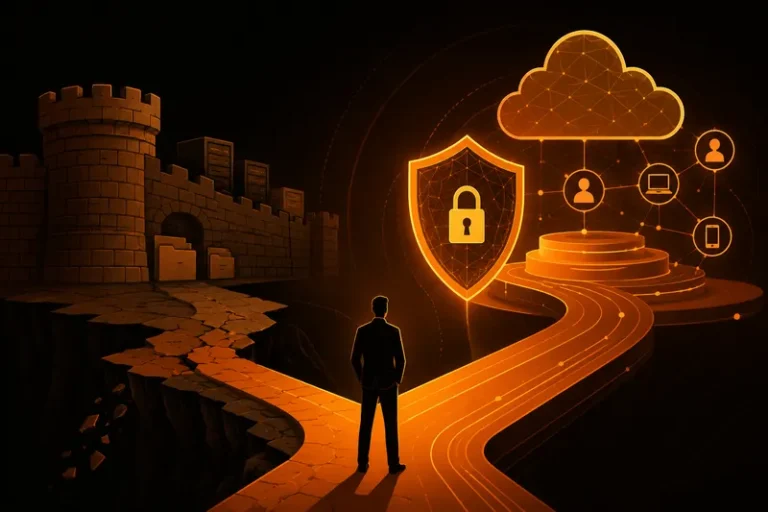


Here is a scenario unfolding inside hundreds of Indian mid-market and enterprise security teams right now. The CISO is staring at three separate dashboards, one for AWS, one for Azure, one for GCP. There are fourteen open tickets in Jira, six of which are misconfiguration alerts that have been sitting for eleven days. The two L2 analysts on duty are buried in false positives from a SIEM that was tuned for on-premise log streams. And somewhere in this noise, a privilege escalation is quietly happening across a workload that nobody has bothered to map to a function category.
This is not a technology failure. It is an organizational design failure, and it is the most expensive kind, because it is invisible until the breach report arrives.
A peer-reviewed case study from Germany, recently published in academic literature, examined exactly this problem. The paper, “Planning Distributed Security Operations Centers in Multi-Cloud Landscapes,” followed a mid-size organization through a rigorous, systems-theory-based process of redesigning their SOC for a multi-cloud world. Their conclusion carries a direct message for Indian enterprise security leaders: the traditional, monolithic, internally-run SOC is structurally incompatible with multi-cloud strategy. What replaces it is a distributed SOC, an adaptive architecture where internal teams retain strategic control while specialized external providers handle the execution of tasks where they hold a genuine “know-how advantage.”
This isn’t outsourcing your security and hoping for the best. It is something more deliberate, more structured, and more powerful. And for India’s CISOs navigating a talent crisis of over 1 million unfilled cybersecurity roles, a tightening DPDP Act enforcement calendar, and a CERT-In framework that now mandates 24/7 SOC capabilities, the distributed SOC model is no longer a future option. It is a present imperative.
Part 1: The Multi-Cloud Work Organization Problem Nobody Talks About
How Cloud Strategy Changed the Nature of IT Work; and Left Security Behind
To understand why conventional SOCs struggle in multi-cloud environments, you first have to understand how multi-cloud fundamentally changed the nature of IT work.
In traditional on-premise environments, IT staff spent the bulk of their time on administration: deploying hardware, maintaining software stacks, building custom connectors, managing physical infrastructure. This was continuous, recurring, labor-intensive work with limited strategic value, necessary but not differentiated.
Multi-cloud changed the equation. In a mature multi-cloud environment, the repetitive administration work collapses. Infrastructure-as-a-Service removes physical hardware concerns. Platform-as-a-Service removes most software administration. Software-as-a-Service eliminates deployment entirely. What remains for IT teams are configuration tasks, done once at deployment, or when functional requirements change, and strategic work that genuinely adds value.
The research articulates this shift with precision: “Repetitive administration and programming tasks with no added value are replaced by on-demand configuration tasks, which immediately enable productivity.”
But here is the critical failure point for security teams: the SOC never received this memo.
Most Indian enterprise SOCs are still organized around the on-premise paradigm, built to handle continuous, recurring operational tasks in a homogeneous technical environment. When the organization moved to AWS, Azure, and GCP simultaneously, the SOC absorbed a new order of complexity without receiving a structural redesign. The result: analysts drowning in cloud-specific log formats, multi-cloud IAM models that don’t translate across providers, and security controls that were never designed to span the full function landscape of a modern multi-cloud IT estate.
Do Give it a Read: Defending the Cloud: Key Vulnerabilities, Evolving Cybersecurity Challenges, and How Enterprises Can Stay Ahead
The Five Functions Your SOC Must Cover, and Usually Doesn’t, Coherently
Before you can distribute a SOC intelligently, you need to define what it actually does. The research identifies five core functional task groups, and the specific sub-tasks within each. Understanding this taxonomy is essential for any CISO beginning a SOC redesign.
| SOC Function | Sub-Tasks | Strategic Role |
|---|---|---|
| Intelligence | Knowledge Management, Threat & Risk Analysis | Competence center, advises development, NOC, and IT on security architecture and emerging threats |
| SIEM | Monitoring, Data Collection (SIM), Security Event Management/Reaction (SEM) | Operative core, continuous visibility and incident response |
| Baseline Security | Vulnerability Management, Compliance Scans | Maintenance function, eliminates known weaknesses, ensures configuration standards |
| Forensics | Data Analysis, Investigation, Compliance Reports | Reporting and evidence function, serves CIO decision-making and regulatory compliance obligations |
| Pentests | Planning, Execution | Validation function, confirms security posture against real-world adversary techniques |
Two of these five, SIEM and Baseline Security, form the operative-technical core of any SOC. They are the functions most directly affected by multi-cloud complexity, and the functions where internal teams in most Indian organizations are most severely under-resourced.
Must Read: Cloud Security Visualization & Attack Path Analysis: The Complete Guide to Modern Threat Detection
Part 2: Mapping the Threat to Your IT Landscape, The Relationship Matrix Approach
The research’s central contribution is a systematic method for SOC planning based on relationship matrices, a tool drawn from systems theory and commonly used in operations research. The idea is elegantly simple: create a structured map that relates SOC functions to the distinct IT function categories in your organization, then use that map to make rigorous, evidence-based decisions about work distribution between internal and external actors.
Abstracting Your IT Landscape Into Security-Relevant Categories
The research identified twelve function groups in the case study organization, from print production machines to business applications, cloud IAM, and AWS-hosted digital platforms. But a twelve-by-twelve planning matrix is unwieldy for executive decision-making. The solution is abstraction: grouping function groups by their common security characteristics into five high-level categories.
For Indian enterprises, an analogous abstraction might look like this:
| Category | What It Covers in an Indian Enterprise Context |
|---|---|
| A: Operational Technology (OT) | Manufacturing controls, SCADA systems, telephony, building management systems |
| B: Common Infrastructure (Infra) | Network equipment, routers, switches, endpoint devices, VPN infrastructure |
| C: Core Security (Sec) | Security tooling, data backup/recovery systems, test environments |
| D: Application Services (Serv) | Application infrastructure, directory services (AD/LDAP), remote access, IAM platforms, cloud IAM (AWS IAM, Azure AD, GCP IAM) |
| E: Business Functions (BF) | ERP/SAP, CRM, cloud-native SaaS applications, content management, AWS/GCP-hosted business platforms |
This abstraction does more than simplify planning. It enables group-wise security reporting, a requirement under CERT-In’s 2025 comprehensive audit guidelines, which mandate structured security posture documentation by system category for compliance evidence.
Seven Security Controls Your SOC Must Apply, and Where They Apply
Within SIEM and Baseline Security, the research identifies seven specific security controls that the SOC must apply across function categories. Understanding which controls apply to which categories is the foundation for intelligent work distribution:
| Control | Token | What It Does |
|---|---|---|
| Communication Monitoring | S.Com | Inspects data traffic between network nodes for anomalies, from volume logging to Deep Packet Inspection |
| Access Monitoring | S.Acc | Observes access requests using protocol-level inspection (DNS, LDAP, SMTP, REST, API calls); core input for IAM log analysis |
| Application Monitoring | S.App | Captures security events in business applications through log collection; often requires proprietary format parsing |
| Intrusion Detection | S.ID | Meta-control combining S.Com, S.Acc, S.App, and endpoint data to detect active breaches via IDS systems |
| Endpoint Security | B.Ept | Manages endpoint access rights, configurations, virus scanners, and remote monitoring agents |
| Vulnerability Management | B.Vuln | Detects and eliminates security deficiencies through external CVE feeds, manufacturer advisories, and configuration audits |
| Perimeter Security | B.Peri | Maintains static and dynamic network boundaries via firewalls, VPNs, and network segmentation |
In a multi-cloud environment, these controls interact with a radically heterogeneous technology landscape. AWS CloudTrail, Azure Activity Logs, and GCP Audit Logs all speak different dialects. AWS IAM policies and Azure RBAC encode “admin” differently. AWS Security Groups and Azure NSGs have different rule models. Every one of these differences creates friction in the application of these seven controls, friction that absorbs analyst time without generating security value.
Part 3: The Three SOC Models, and Why Most Indian Enterprises Are Stuck in Model 1
The research developed three distinct models for external provider involvement in a distributed SOC, ranging from minimal engagement to maximum outsourcing. Understanding where your organization sits, and where you should be, is the strategic core of SOC redesign.
Model 1: Status Quo (Marginal External Involvement)
In the status quo model, external parties are used almost exclusively as information sources rather than operational partners. Cloud providers contribute security bulletins and automated log feeds. Pentests are executed externally, because specialized firms have a recognized know-how advantage and cognitive independence is essential for valid results, but are planned entirely internally. Everything else stays in-house.
This model is viable for organizations with mature, well-staffed internal security teams and a relatively simple IT landscape. For most Indian mid-market firms in 2025, it is not. India’s demand for cybersecurity professionals is expected to hit one million, but the country currently has only about 80,000 qualified experts, a structural gap that makes the status quo model an exercise in understaffing a function that cannot afford to be understaffed.
Do Give it a Read: How Attackers Exploit Cloud Storage Misconfigurations: Real Breaches, Attack Techniques & Prevention Strategies
Model 2: Maximum External Involvement (High Outsourcing)
At the other extreme, the maximum involvement model delegates most operational and some strategic SOC functions to external providers. The SIEM provider autonomously collects and monitors data across all cloud platforms, leads incident analysis, and specifies (and where possible implements) incident response measures. Forensics is conducted independently by the provider. Pentests are both planned and executed externally.
The research is candid about the organizational dependency this creates: “The organization becomes largely dependent on external service providers in this model.” For Indian enterprises handling DPDP-regulated personal data, operating under RBI frameworks, or classified as Critical Information Infrastructure by CERT-In, this level of dependency introduces third-party risk that compliance frameworks actively discourage.
Model 3: The Planning Target (Calibrated Distribution)
The third model, described in the research as “a middle ground, as a basis for planning in a short to medium timeframe,” is where the architecture becomes genuinely powerful. It distributes SOC tasks according to a principled analysis of where internal and external teams hold genuine advantages, creating a configuration that is neither fully outsourced nor hopelessly understaffed.
In this model:
- Intelligence: External providers contribute specialized risk analyses and threat intelligence in areas of infrastructure and application services where they hold deep expertise. Internal teams retain strategic SOC oversight and intelligence management.
- SIEM: Providers independently monitor cloud services with their own technical tools and take on core SIM (Security Information Management) tasks. Internal staff, small, focused, and empowered, handle SEM (Security Event Management): the response planning, reaction execution, and incident decisions that require institutional knowledge.
- Baseline Security: Providers conduct compliance scans and vulnerability reporting using their extended technical capabilities. Internal SOC retains ownership of patching and configuration updates, the activities requiring access to internal systems.
- Forensics: Providers contribute significantly to data analysis and compliance reporting in their areas of competence. Case-by-case engagement for independent investigations.
- Pentests: External execution remains standard; providers with deep knowledge of the environment from SIEM engagement can contribute intelligently to planning.
This model has a critical insight at its core: liberate your internal SOC analysts from repetitive operational tasks so they can focus on what only they can do, institutional context, strategic decision-making, and the SEM response capability that depends on knowing your own environment.
Part 4: The Real Cost of Getting This Wrong in India’s Regulatory Environment
The strategic case for distributed SOC design becomes regulatory imperative when you map it against India’s 2025 compliance landscape.
CERT-In’s July 2025 Comprehensive Cyber Security Audit Guidelines mandate 24/7 SOC coverage, 180-day SIEM log retention with cryptographic integrity, and independent third-party security audits conducted annually. These requirements effectively codify the distributed SOC model in regulatory language: 24/7 coverage implies external engagement for organizations that cannot staff round-the-clock internally; independent audits require the cognitive separation that external pentesting provides; and 180-day SIEM retention at cloud scale demands the data management infrastructure that specialized SIEM providers bring.
Read More on CERT-In: New CERT-In Guidelines 2025: Key Takeaways for Cloud Security Compliance
The DPDP Rules 2025, notified in November 2025, add penalty exposure of up to ₹250 crore for data breaches attributable to inadequate security safeguards. Significant Data Fiduciaries must conduct annual Data Protection Impact Assessments. For organizations running personal data workloads on cloud platforms — which now includes virtually every Indian fintech, BFSI organization, healthcare enterprise, and e-commerce platform — the forensics function of the SOC becomes a direct compliance asset: generating the structured incident documentation and compliance reports that regulatory investigations demand.
Read More on DPDP Rules Implementation: DPDP Rules Are Here: India’s 12/18‑Month Rollout, the 72‑Hour Breach Clock – and a Cloud‑First Plan Your Board Will Actually Use
RBI’s cloud security frameworks for banking and financial services add data localization constraints and third-party risk management requirements that directly shape which SOC tasks can be delegated to which external providers, and under what contractual and geographic conditions.
Getting distributed SOC design wrong in this environment is not an operational inconvenience. It is a regulatory and financial liability.
Part 5: From Planning Matrix to Statement of Work — and Where the Platform Must Fit
The research demonstrates that the relationship matrix is not merely a planning document. It is a derivation engine: by systematically reducing abstraction levels, you can move directly from a populated planning matrix to a Statement of Work for external providers that is specific, defensible, and operationally executable.
The sample SoW language the research generates for Common Infrastructure and Application Services SIEM engagement provides a template directly applicable to AWS, Azure, and GCP environments:
“The contractor independently monitors the systems via all accessible interfaces and uses its own technology for monitoring. The contractor collects all accessible and security-relevant data, logs, status messages, error reports — structures the collected data and makes it available to the client. The contractor operates a state-of-the-art SEM system to identify security threats and provides, upon recognizing a security incident, an immediate incident report containing: type of incident, affected systems, criticality/risk assessment, allowable reaction time, and available attacker information.”
This is the template. But here is the critical question the research doesn’t explicitly answer: what technology platform sits in the middle of this architecture, giving your internal SOC real-time visibility across the entire multi-cloud estate without requiring them to log into fourteen separate provider consoles?
That is the gap where Cy5’s ion Cloud Security Platform closes the architectural loop.
Part 6: Where Ion Fits in the Distributed SOC Architecture
The distributed SOC model described in the research rests on a fundamental premise: that internal teams can maintain strategic visibility while external providers handle operational execution in specific domains. This premise fails entirely if your internal SOC team is operating blind, dependent on provider reports and scheduled SIEM dashboards to understand what is happening in real time across your cloud estate.
Ion is the platform that ensures they are never blind.
Continuous SIEM Data Foundation Across All Cloud Sources
The SIEM function, and specifically the SIM (Security Information Management) sub-task, depends on comprehensive, structured data collection across all monitored systems. In a multi-cloud environment spanning AWS CloudTrail, Azure Activity Logs, GCP Audit Logs, and on-premise SIEM feeds, this data arrives in incompatible formats, on different schedules, and with different coverage granularities.
Ion’s Security Data Lake ingests and normalizes security telemetry from across all major cloud providers, AWS, Azure, GCP, and Oracle Cloud, through a unified SQL interface. This gives your internal SOC team a single operational picture across the entire estate: not a summary of what an external provider chose to escalate, but the actual security telemetry, queryable in real time. External SIEM providers can operate with the same data foundation, eliminating the coverage gaps that emerge when providers rely on the logs they can access rather than the logs that matter.
Real-Time, Event-Driven Monitoring, The Antidote to the 6-Hour Detection Blind Spot
The research’s planning models assume external SIEM providers will “independently monitor systems via all accessible interfaces.” But there is a structural failure in most MSSP and external SIEM engagements that the research doesn’t explicitly surface: periodic scanning creates detection blind spots that an attacker can operate within.
If your CSPM scans run every 6 hours and an attacker compromises credentials at 3 PM, they potentially have until 9 PM to exfiltrate data, escalate privileges, and cover their tracks before your next scan even detects the initial compromise. In a distributed SOC model where your SEM response capability sits internally, this detection delay is not acceptable, your analysts cannot respond to incidents they are not yet aware of.
Also Read: Risk-Based CSPM: The Complete Guide to Contextual Cloud Risk Management
Ion’s event-driven architecture captures every API call, configuration change, and state transition as it happens. Every security-relevant event in your cloud environment triggers immediate analysis. There is no detection blind spot. The external provider’s SIM data collection, and the internal team’s SEM response capability, both operate on real-time signals rather than batch reports.
Contextual Attack Path Analysis, Making the Relationship Matrix Dynamic
The static planning matrix the research develops is designed for strategic planning. Your security posture, however, changes continuously: new resources deploy, permissions change, configurations drift, new attack techniques emerge. A static matrix cannot reflect this dynamism.
Ion’s Contextual Graph continuously maps relationships between cloud resources, identities, configurations, and vulnerabilities — dynamically updating the attack path landscape as your environment changes. This gives your internal SOC team the real-time contextual picture that the relationship matrix represents at planning time: which function categories are currently most exposed, which identity permutations create exploit paths, and which findings represent genuine risk versus theoretical configuration drift.
For the Baseline Security function, where the research prescribes vulnerability management and compliance scanning, ion’s integrated vulnerability management module provides continuous discovery and prioritization across VMs, containers, and serverless functions, agentlessly, without requiring the access overhead that creates friction in external provider engagements.
CIEM for the Identity-Heavy Multi-Cloud SOC
The research highlights IAM as a domain where interoperability is “already highly developed” in multi-cloud environments, but operational complexity remains high. Managing identities across AWS IAM, Azure Active Directory, and GCP IAM simultaneously, while enforcing least-privilege principles under CERT-In and DPDP requirements, is a function that belongs squarely in the Access Monitoring (S.Acc) and Endpoint Security (B.Ept) security controls.
Ion’s CIEM capability continuously analyzes identity permissions across all cloud providers, identifying dormant accounts, over-privileged roles, exposed access keys, and MFA gaps that represent disproportionate risk. For the internal SOC team operating a distributed model, CIEM provides the identity intelligence that external SIEM providers cannot generate without direct access to your IAM configurations.
CERT-In Compliance Automation, Forensics Without the Fire Drill
The Forensics function in the distributed SOC model generates the reports that serve your CIO’s decision-making and your compliance department’s regulatory obligations. Ion’s continuous posture monitoring and structured logging — with 180-day retention aligned to CERT-In’s Section 6.xxi requirements, means compliance evidence is continuously generated as a by-product of normal operations, not assembled under pressure during an audit.
Frequently Asked Questions
A distributed SOC is a security operations model where internal teams retain strategic oversight and high-judgment response functions, while specialized external providers handle specific operational and technical tasks where they hold a genuine expertise advantage. For Indian enterprises facing a talent gap of over 800,000 unfilled cybersecurity positions, the distributed model is a structural response to a structural problem, enabling organizations to maintain effective SOC coverage without the impossible task of hiring a full-scale internal team.
The research-backed approach uses a relationship matrix: map your SOC’s five core functions (Intelligence, SIEM, Baseline Security, Forensics, Pentests) against your IT function categories (OT, Common Infrastructure, Core Security, Application Services, Business Functions), then assess each cell for internal versus external contribution based on expertise requirements, access constraints, and institutional knowledge needs. Functions requiring deep institutional context, especially SEM/incident response, should remain primarily internal. Functions with standardizable tooling and external know-how advantages — especially pentest execution and infrastructure SIEM monitoring, are strong candidates for external engagement.
SIEM (Security Information and Event Management) consists of two complementary sub-functions. SIM (Security Information Management) handles monitoring and data collection, aggregating logs, status messages, and security telemetry from all monitored systems into a structured, queryable dataset. SEM (Security Event Management) handles detection, alerting, and the coordination of response activities when security incidents are identified. In a distributed SOC, SIM is a strong candidate for external provider execution, while SEM, which requires institutional knowledge to distinguish genuine incidents from false positives, typically benefits from internal ownership.
External pentest execution is standard practice for two reasons the research explicitly articulates. First, specialized security firms have developed considerable expertise advantages through continuous exposure to diverse environments and evolving attack techniques. Second, and critically, cognitive bias: internal teams develop familiarity with their own systems that leads them to unconsciously avoid or underweight certain attack vectors. External parties bring genuine adversarial independence, they will try what internal teams might assume is impossible.
CERT-In’s July 2025 comprehensive guidelines effectively mandate several elements of the distributed SOC model. The 24/7 coverage requirement implies external engagement for organizations that cannot staff continuous internal operations. The 180-day SIEM log retention with integrity hashing requires the data management infrastructure typically provided by specialized SIEM platforms. The independent third-party audit requirement mandates the organizational separation that the pentest planning model prescribes. Organizations that treat these mandates as discrete compliance checkboxes rather than design requirements for their SOC architecture are building compliance theater, not resilience.
The relationship matrix approach provides a systematic derivation path. Start by populating the matrix with your IT function categories and the SOC task distribution model you are targeting. For each cell with significant external involvement, enumerate the specific security controls (monitoring, access monitoring, intrusion detection, vulnerability management, etc.) and the corresponding IT systems and interfaces. Specify the contribution level (external leads vs. internal leads), the data access requirements the provider needs, the expected output formats (incident reports, compliance documentation), and the response time SLAs for incident notification. The research provides a detailed sample SoW extract for Common Infrastructure and Application Services SIEM that can serve as a template.
Conclusion: Stop Reorganizing Around the SOC You Have. Build the One You Need.
The hardest part of distributed SOC planning is not the relationship matrix. It is not the SoW derivation. It is not the provider selection process that follows.
The hardest part is accepting that the SOC structure you have today, built for an on-premise world, staffed for a talent market that no longer exists, organized around full internal ownership, is not the one you need for a multi-cloud organization in 2025.
India’s cloud transformation is not waiting for your SOC to catch up. 93% of Indian companies are increasing their cybersecurity budgets, and the regulatory apparatus; DPDP, CERT-In, RBI, SEBI, is demanding demonstrable, continuous security operations that most internal-only SOCs simply cannot deliver. The cybersecurity talent shortage means that hiring your way to coverage is not a viable strategy for most organizations.
The distributed SOC model the research describes is not a compromise. It is a structural upgrade: liberating your internal analysts from the repetitive operational tasks that burn them out and deliver no strategic value, redirecting their capacity toward the high-judgment, institutionally-informed work that only they can do, and bringing external providers’ specialized expertise and tooling to bear exactly where it adds the most.
But the model only works if your internal team can see everything. If they are operating blind, dependent on provider summaries, periodic reports, and batch SIEM dashboards, they cannot exercise the strategic oversight the model requires.
That is why the platform at the center of your distributed SOC architecture matters as much as the organizational design that surrounds it. Cy5’s ion Cloud Security Platform gives your internal team continuous, real-time, contextually intelligent visibility across the entire multi-cloud estate, so the strategic layer of your distributed SOC is never operating on yesterday’s information.
See how ion powers the internal core of a distributed SOC. Schedule a demo →