
In this Guide, You will Learn:-
- How cloud storage bucket policies work across AWS S3, Azure Blob, and GCP; and the specific architectural differences that create multi-cloud governance gaps.
- The 3-Control Bucket Security Model: a named framework for evaluating and enforcing least privilege storage access across cloud environments
- Two Indian enterprise scenarios where bucket policy misconfigurations created documented compliance and breach risk.
- Four security recommendations for DevSecOps teams managing bucket policies at scale with automated detection.
Estimated Reading Time: 10 minutes | Technical-strategic depth — architecture, code examples, India regulatory context | Last Updated: February 2026
Introduction
The developer opened the S3 bucket for a staging integration test. He set the bucket policy to allow public reads to unblock a colleague in another team. He meant to revert it after the test. The test ran, the sprint moved on, and the bucket stayed open. Seven months later, a security researcher found 1.2 million customer records accessible without authentication and filed a responsible disclosure. The bucket policy had been in that state since the day it was modified.
Cloud storage bucket policies are the most consequential and least reviewed access control mechanism in the average cloud environment. They are written by developers solving immediate problems, reviewed infrequently, and almost never evaluated in the context of the full cloud environment surrounding them. The IBM Cost of a Data Breach Report 2023 found that misconfigured cloud storage is among the top three initial attack vectors in cloud breaches globally.
For Indian enterprises subject to DPDP Act 2023 data breach notification requirements, a misconfigured bucket containing personal data is not just a security failure. It is a regulatory event with mandatory disclosure obligations and potential penalties. Getting bucket policies right is now a compliance architecture decision, not just a DevOps task.
Cloud Storage Misconfiguration Is the Breach Vector Security Teams Underestimate Most
Bucket policy misconfiguration occupies a specific and uncomfortable position in cloud security: it is simultaneously the most preventable and most frequently occurring initial access vector. The Verizon DBIR 2023 found that misconfiguration errors; of which storage bucket exposure is the leading category, accounted for 21% of all cloud breaches. The technical barrier to exploitation is near-zero: an attacker needs only a URL and an unauthenticated GET request to access a publicly exposed bucket. The detection barrier, without automated scanning, is equally near-zero in the other direction; these misconfigurations can sit undetected for months.
The governance problem is structural. Bucket policies are typically written and modified by developers with immediate operational intent, unblock a CI/CD pipeline, enable a cross-team integration, allow a vendor temporary access. Each individual policy change is rational in context. Accumulated over months and years across hundreds of buckets, the result is a storage layer with no coherent access model and no team that owns the full picture. Indian enterprises face this amplified by rapid cloud adoption: NASSCOM’s 2023 report found that Indian organizations were deploying cloud workloads at triple the global average rate, with security governance consistently lagging infrastructure growth.
Did You Know?
The average enterprise cloud environment has 23% of its storage buckets with at least one overly permissive access policy, most introduced through developer workflow shortcuts, not malicious intent. Source: Palo Alto Unit 42 Cloud Threat Report 2023.
The gap between how bucket policies are written and how they should be governed is where most cloud storage breaches begin. The next section explains why the conventional approach to closing that gap fails in practice.
Read More: Cloud Misconfiguration Detection: Complete Guide for 2026 (AWS, Azure, GCP & Best Practices)
Bucket Policy Reviews Do Not Solve the Bucket Policy Problem
Most security programs address bucket policy risk through periodic reviews: quarterly access audits, annual policy cleanup sprints, post-incident remediation exercises. This approach treats bucket policy risk as a point-in-time governance problem when it is actually a continuous drift problem. A bucket that is correctly configured today can be misconfigured by tomorrow morning’s deployment pipeline. A policy reviewed in last quarter’s audit was reviewed against last quarter’s environment, not today’s.
Most security teams believe that reviewing bucket policies catches bucket policy risk. Here is the specific cost of that belief: in the average enterprise, developers modify bucket policies an estimated 15–20 times per week across a cloud environment. A quarterly review covers that activity 12–16 weeks after it occurred. In a breach scenario, 12 weeks of unreviewed policy changes is 12 weeks of undetected exposure. The correct architecture is continuous detection, not periodic review.
| Periodic Review Approach | Continuous Detection Approach |
|---|---|
| Quarterly policy audit against a static snapshot of current bucket configurations | Event-driven detection firing within seconds of any bucket policy change that introduces over-permissive access |
| Manual cross-referencing of bucket policies against IAM roles, analyst-hours per audit | Automated correlation of bucket policy with adjacent IAM permissions, surfacing dangerous combinations as named risks |
| DPDP Act compliance evidence assembled retrospectively from audit exports | Continuous compliance posture tracking: personal data buckets monitored in real time against DPDP Act access controls |
“A bucket policy review tells you what your storage access looked like last quarter. Continuous detection tells you what it looks like right now, which is the only version that matters.”
Do Give it a Read: How to Implement Secure Design Principles in Cloud Computing: The 2025 Practitioner’s Playbook
The 3-Control Bucket Security Model: A Framework for Governing Cloud Storage Access at Scale
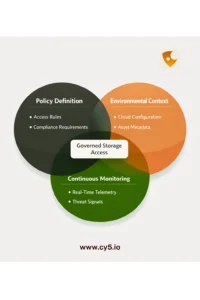
Secure bucket policy governance requires three controls operating simultaneously, not sequentially. The 3-Control Bucket Security Model provides the evaluation framework for determining whether your current storage security architecture achieves genuine protection or creates an audit-ready appearance of it.
Control 1: Least Privilege Policy Definition
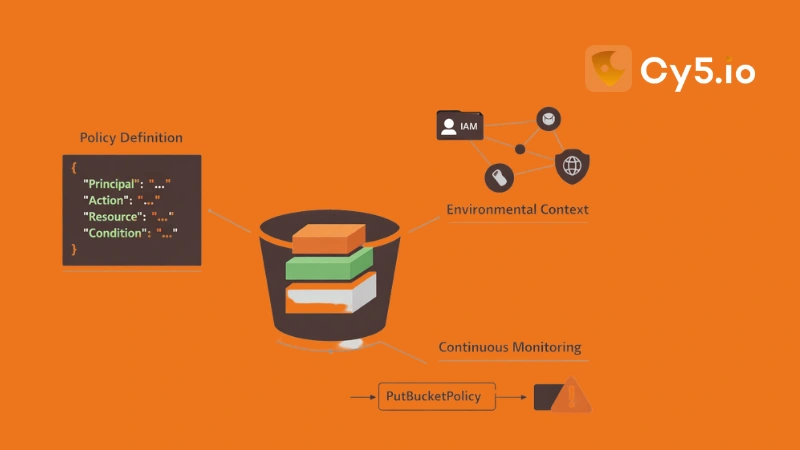
Every bucket policy should grant the minimum permissions required for the specific use case; by principal, by action, and by condition. A well-structured S3 bucket policy restricts access to specific IAM ARNs, limits permitted actions to those the use case requires (s3:GetObject for read-only, never s3:* as a wildcard), and applies condition keys for IP restriction or MFA requirement where applicable. What good looks like: no bucket policy in production contains a Principal of “*” (public access) or an Action of “s3:*” without explicit justification documented in a security review.
AWS S3 Least Privilege Policy Example
{
  "Version": "2012-10-17",
  "Statement": [{
    "Effect": "Allow",
    "Principal": { "AWS": "arn:aws:iam::123456789:role/app-read-role" },
    "Action": ["s3:GetObject"],
    "Resource": "arn:aws:s3:::prod-customer-data/*",
    "Condition": { "Bool": { "aws:SecureTransport": "true" } }
  }]
}
Control 2: Environmental Context Enrichment
A bucket policy evaluated in isolation tells half the story. The complete risk picture requires knowing: what data is stored in the bucket (PII, financial records, credentials, logs), which IAM principals can access it beyond the explicit bucket policy (through resource-based policy interactions), and what network paths lead to the bucket from the public internet. What good looks like: every bucket containing personal data under the DPDP Act is tagged with a data classification label that triggers automatic access control validation against a least privilege baseline, flagging any policy that permits access beyond the approved set.
Control 3: Continuous Change Detection
Policy drift is inevitable in active engineering environments. The control that prevents drift from becoming exposure is event-driven monitoring: every bucket policy modification triggers immediate re-evaluation against the least privilege baseline and the data classification of the affected bucket. What good looks like: an AWS CloudTrail event recording a PutBucketPolicy API call fires an automated evaluation within 60 seconds, comparing the new policy to the approved baseline and generating a remediation alert if the change introduces public access or wildcard permissions.
Cy5’s ion Cloud Security platform implements Control 3 through its event-driven CSPM architecture; PutBucketPolicy and equivalent Azure and GCP storage API events trigger immediate policy evaluation against the least privilege model, surfacing violations within seconds for Indian enterprise environments where CERT-In’s 6-hour reporting mandate makes detection latency a compliance variable, not just an operational one.
Cloud Storage Bucket Policy Failures in Indian Enterprise Environments
Scenario 1: The Fintech Whose Staging Bucket Policy Reached Production Data
A Pune-based Series B lending fintech ran separate AWS accounts for development, staging, and production environments. A developer configuring a cross-environment data migration tool added a bucket policy to the staging account allowing read access from the production account’s Lambda execution role, a legitimate operational need for the migration workflow. The policy was approved in a code review focused on the Lambda function, not the bucket permission it created.
What the review missed: the production Lambda execution role had broader permissions than the migration workflow required, including access to production customer loan application records. The staging bucket policy, combined with the Lambda role’s permissions, created a path from the staging environment, which had weaker network controls, to production PII. The path remained open for four months post-migration. Under the DPDP Act, this constituted unauthorized personal data access risk requiring assessment and potential disclosure. A Control 3 event-driven detection layer would have flagged the cross-account policy within seconds of creation.
Scenario 2: The GCC That Failed Its Parent Company’s Cloud Security Audit
A Bengaluru-based GCC managing cloud infrastructure for a German automotive group ran Azure Blob Storage for its analytics workloads. Storage account access policies had been configured by the original infrastructure team and were last reviewed 18 months prior. When the parent company’s Group CISO commissioned an annual cloud security audit, the auditors found three Azure storage containers with anonymous read access enabled, a configuration that had been set during a proof-of-concept exercise and never disabled.
None of the three containers held sensitive data at the time of the original configuration. By the time of the audit, business needs had evolved: one container held intermediary analytics files containing aggregated employee performance data. The GCC’s security team had no mechanism to detect when data classification changed relative to storage access policy. A Control 2 environmental context layer, continuously mapping data classification to access policy, would have flagged this mismatch the moment the new data type was introduced.
Must Read: Risk-Based CSPM: The Complete Guide to Contextual Cloud Risk Management
Four Recommendations for DevSecOps Teams Governing Bucket Policies at Scale
1. Enforce Bucket Policy as Code from the First Deployment
Every bucket policy should originate from a version-controlled IaC template, Terraform, AWS CloudFormation, Azure Bicep, or Google Deployment Manager; with security review in the CI/CD pipeline before deployment. Ad hoc console modifications are the primary source of policy drift. Enforcing IaC-only policy management eliminates the category of changes that occur outside the review process entirely.
You have done this correctly when: no bucket in your production environment has a policy that cannot be traced to a specific version-controlled IaC commit with an associated code review approval.
2. Classify Every Bucket Before Defining Its Access Policy
Data classification drives access policy. A bucket containing server logs requires a different least privilege model than a bucket containing customer PII under the DPDP Act or financial transaction records under RBI’s IT Governance framework. Classification-first policy design prevents the scenario in Section D Scenario 2: a policy written for low-sensitivity data applied to a bucket that later holds regulated data. Make classification a deployment gate, not a retrospective task.
3. Deploy Event-Driven Policy Change Detection; CERT-In Requires It
CERT-In’s 6-hour breach reporting mandate requires that organizations detect storage access policy changes that create personal data exposure within a window that periodic review cannot satisfy. Event-driven detection; monitoring CloudTrail PutBucketPolicy events, Azure Storage diagnostic logs, and GCP Cloud Audit Logs for policy changes in real time, is the minimum architecture for CERT-In compliance in environments holding personal data. Organizations still relying on scheduled CSPM scans have a structural compliance gap for any bucket containing DPDP Act-regulated data.
4. Automate Least Privilege Validation as a Continuous Control, Not a Project
Continuous cloud security posture management platforms that evaluate bucket policies against a defined least privilege baseline on every change, flagging wildcard permissions, public access configurations, and cross-account access without business justification, reduce bucket misconfiguration exposure by documented 85–96% compared to periodic manual review. The operational question is not whether to automate; it is which platform implements the 3-Control model with genuine event-driven detection rather than scheduled scanning with a real-time dashboard label.
Where to Start?
- Step 1 (This Week)
Run a bucket inventory:- list every storage bucket across all cloud providers, its current access policy, and its data classification. This single exercise surfaces most high-severity misconfigurations without any tooling.
- Step 2 (This Month)
Migrate bucket policy definition to IaC with CI/CD pipeline enforcement. Block console-only modifications.
- Step 3 (This Quarter)
Deploy event-driven policy change detection. Measure alert latency from PutBucketPolicy to detection.
What Security Frameworks and Independent Research Say About Storage Access Governance
CIS Controls v8 Control 3 (Data Protection) and Control 5 (Account Management) together mandate data classification-driven access control and continuous monitoring of access policy changes, the precise combination that Controls 1 and 3 of the 3-Control Bucket Security Model implement. NIST SP 800-53 Rev 5’s AC-3 (Access Enforcement) and AU-12 (Audit Record Generation) controls map directly to least privilege policy enforcement and event-driven change detection for cloud storage environments.
The Palo Alto Unit 42 Cloud Threat Report 2023 found that storage misconfiguration detection time averaged 197 days in organizations without continuous posture monitoring, compared to under 1 hour in organizations with event-driven CSPM. That 197-day gap is the window DPDP Act enforcement will evaluate breach exposure against.
Cy5’s ion platform is deployed across Indian BFSI, telecom, and GCC environments with documented sub-60-second bucket policy change detection.
The Bucket That Is Misconfigured Right Now Will Not Wait for Your Next Audit
Cloud storage bucket policies are not a configuration problem. They are a continuous governance problem, one that manifests as a configuration failure the moment detection lags behind modification. The gap between when a developer changes a policy and when your security team knows about it is the gap where breaches live.
The 3-Control Bucket Security Model; least privilege definition, environmental context, continuous detection, closes that gap structurally. It is not a product recommendation. It is the minimum architecture for any organization holding personal data under the DPDP Act, financial records under RBI’s IT governance framework, or regulated data under CERT-In’s reporting mandate.
Start with the bucket inventory this week. The exercise alone typically surfaces two or three misconfigurations that no scheduled tool has flagged. What you find will make the business case for everything that follows. If you want a second opinion on the findings, the conversation is available.
Questions DevSecOps and Security Leaders Ask About Cloud Storage Bucket Policies
Cloud storage bucket policies are resource-based access control documents attached directly to a storage container, an AWS S3 bucket, Azure Blob Storage container, or GCP Cloud Storage bucket; that define which principals can perform which actions on the storage resource and under what conditions. Unlike IAM identity-based policies, bucket policies are evaluated at the resource level and can grant or deny access to specific AWS accounts, IAM roles, or, in the most dangerous configuration, the public internet.
An S3 bucket policy is a resource-based policy attached to the bucket itself, defining who can access it from outside or within the AWS account. An IAM policy is an identity-based policy attached to a principal (user, role, or group), defining what AWS resources that principal can access. Effective S3 access is determined by the intersection of both: a principal needs permission from both its IAM policy and the bucket policy, unless the bucket policy grants public access, which overrides IAM entirely.
The least privilege model for bucket policies grants only the minimum permissions required for a specific use case: a defined principal (never “*”), a scoped action list (never “s3:*” without justification), a specific resource ARN (never the bucket root without path restriction where possible), and condition keys enforcing HTTPS transport, source IP restriction, or MFA. Every permission beyond this baseline requires documented business justification reviewed by a security team before deployment.
The five most common bucket policy misconfigurations are: public access enabled through a Principal of “*” or AWS account-level Block Public Access settings overridden; wildcard actions (“s3:*”) granting full control to non-administrative principals; cross-account access without IP or condition restrictions; HTTP transport permitted alongside HTTPS (enabling man-in-the-middle risk); and overly broad resource ARNs granting access to the entire bucket when only a specific prefix path is required for the use case.
Azure Blob Storage does not use bucket policies in the S3 sense, access is governed through Azure RBAC roles (Storage Blob Data Reader, Contributor) at the container or account level, plus Shared Access Signatures for time-limited delegated access. GCP Cloud Storage uses IAM policies at the bucket level (allUsers for public access, specific service accounts for restricted access) plus Uniform Bucket-Level Access which disables per-object ACLs for cleaner governance. All three providers support the least privilege model but implement it through different mechanisms.
Indian enterprises holding personal data in S3 buckets must implement data classification tagging on all buckets containing DPDP Act-regulated data, enforce least privilege access policies with no public access on classified buckets, enable S3 server access logging and CloudTrail data events for audit trail generation, and deploy event-driven detection that alerts on any policy change to a classified bucket within the 6-hour window CERT-In’s breach reporting mandate effectively requires. Periodic audits alone cannot satisfy continuous monitoring obligations.
Bucket policy lifecycle management is the governance process of maintaining storage access policies through their full lifecycle: creation through IaC templates with security review, change management through version-controlled modification with approval workflows, continuous monitoring through event-driven change detection, and periodic review to assess whether existing policies remain appropriate as data classification and business requirements evolve. Without lifecycle management, bucket policies accumulate unreviewed modifications until a misconfiguration produces a breach or audit finding.
Indian enterprises managing cloud storage security at scale implement three controls simultaneously: IaC-enforced policy definition eliminating ad hoc console modifications; data classification tagging that automatically validates access policies against sensitivity requirements for DPDP Act and RBI IT Governance compliance; and event-driven CSPM or CNAPP platforms providing real-time detection of policy changes that introduce public access or wildcard permissions. Cy5’s ion platform provides this three-control coverage natively across AWS, Azure, and GCP for Indian enterprise environments.
A public S3 bucket; one with a Principal of “*” or Block Public Access disabled, allows any internet user to access its contents without authentication. Risk severity depends entirely on what the bucket contains: public buckets holding only truly public assets carry minimal risk; public buckets holding application data, user records, internal documentation, or credentials are immediate breach exposures. The IBM Cost of a Data Breach 2023 estimated the average cost of a cloud misconfiguration breach at $4.45 million globally.
Cloud Security Posture Management (CSPM) tools continuously evaluate bucket policy configurations against security baselines, detecting public access, wildcard permissions, and cross-account access without condition restrictions. The critical differentiator between CSPM implementations is detection architecture: event-driven CSPM that evaluates every PutBucketPolicy API call in real time detects misconfigurations within seconds; scheduled CSPM that polls cloud APIs every 4–24 hours has a detection window during which the misconfiguration exists undetected. For CERT-In-regulated environments, this architectural distinction is a compliance requirement.
Key Takeaways
- Cloud storage bucket policies are the most consequential and least reviewed access control in the average cloud environment; misconfiguration is the leading cloud breach initial access vector.
- The 3-Control Bucket Security Model; Least Privilege Definition, Environmental Context, Continuous Detection, is the minimum governance architecture for regulated Indian enterprises.
- Periodic policy review cannot satisfy CERT-In’s 6-hour breach reporting mandate for storage environments. Event-driven detection is an architectural compliance requirement, not a platform preference.
- Bucket policy risk is not a configuration problem, it is a continuous drift problem. Detection must match the cadence of change, not the cadence of audits.
- Data classification must precede access policy definition. A policy written for low-sensitivity data applied to a later-classified DPDP Act bucket is a DPDP Act compliance gap.
About the Author
Vikram Mehta is Founder & CEO of Cy5 and a 20-year practitioner across offensive security, cloud-native security platform engineering, and DevOps. Former CISO at MakeMyTrip Group (2012–2021); three-time DSCI Excellence Award recipient.