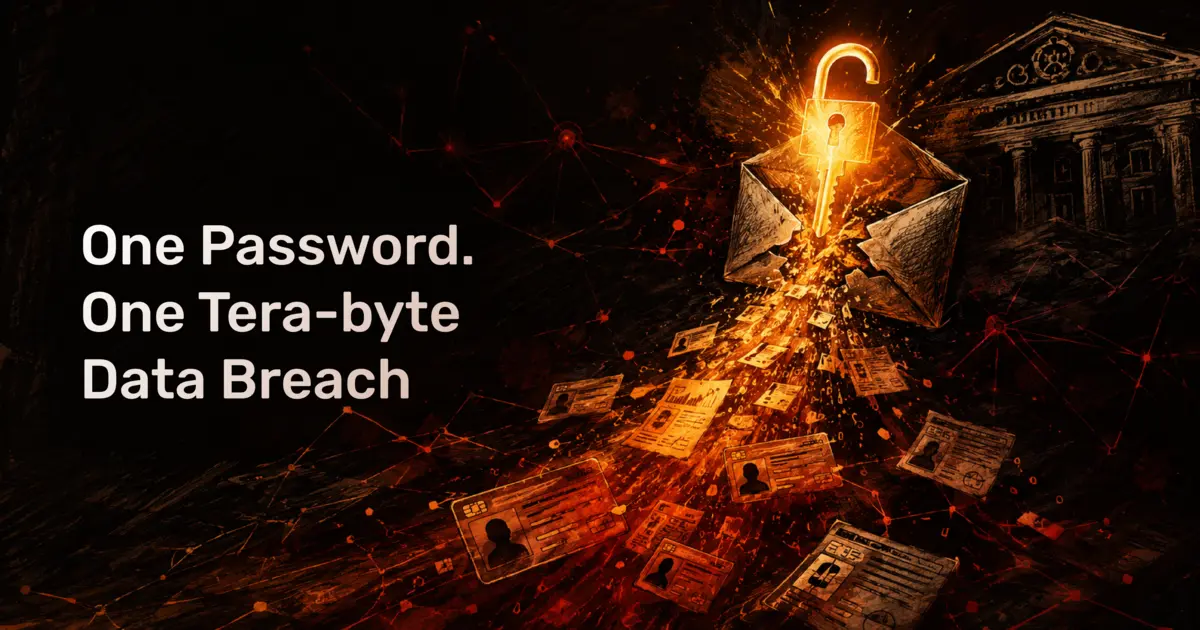

The 30-second version: In late July 2026, roughly 1 terabyte of Bank of Baroda data – customer KYC forms, Aadhaar and PAN copies, loan files, internal audits – surfaced on a dark-web leak site run by a young extortion crew called TripleX. The bank confirmed the cause was disarmingly ordinary: one employee’s email account was compromised. The core banking system was never touched. This is the story of how a single stolen password becomes a national headline — and the security lessons every bank, and every reader, should take from it.
Last updated: 28 July 2026 · ~9-minute read · By the Cy5 Security Research Team
A quiet Thursday, a very loud weekend
On 24 July 2026, a new entry appeared on ransomware.live, a public tracker that catalogues dark-web extortion listings. The victim named was Bank of Baroda (BoB) – India’s second-largest public-sector bank, with tens of millions of customers. The listing claimed roughly 1 TB of stolen data and, unusually, the operators didn’t put a price on it. They simply dumped it for free.
By Monday, 27 July, the bank had gone public. In a measured, carefully worded statement, BoB said: “The incident involved compromise of an employee’s email account, resulting in unauthorised access to certain data. The matter was promptly identified, and immediate containment measures were implemented. The bank’s core banking systems were not accessed and continue to remain secure.”
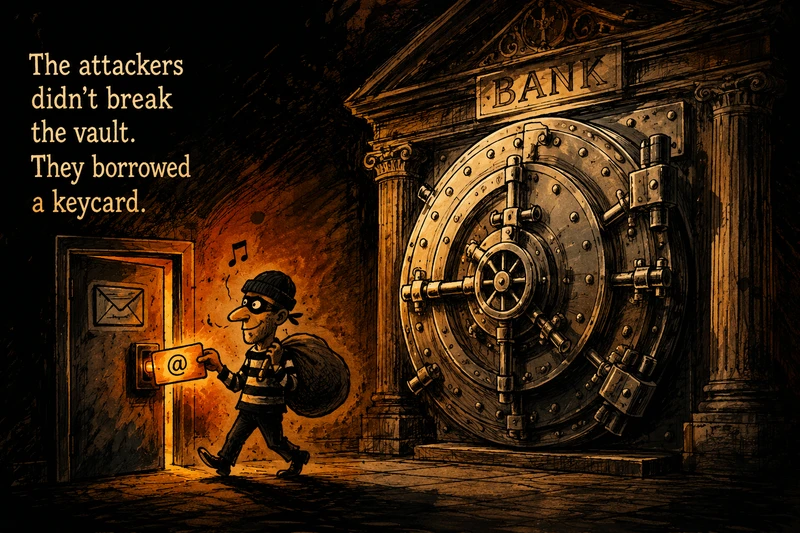
Two sentences. Buried inside them is one of the most important truths in modern cybersecurity, and the whole reason this blog exists. The attackers didn’t break the vault. They borrowed a keycard.
Let’s decode what actually happened, why it worked, and – the part that matters most, how attacks like this get stopped.
What was actually leaked?
Reporting from Business Standard, Deccan Herald, and others, based on the dark-web listing, points to a sprawling and sensitive haul:
- Customer KYC and onboarding data – an estimated 100,000 to 300,000 account-opening application forms, many containing customer photographs and identity documents.
- Government IDs – Aadhaar and PAN numbers tied to real people.
- Account and product data – savings and current accounts, loan accounts, net-banking users, NRI and corporate banking records.
- Internal documents – branch audit reports, loan appraisal files, internal communications, vigilance investigation records, and bob World app audit reports.
- Operational records – branch- and ATM-related data across multiple locations.
Notably, what was not breached is just as important: the Core Banking System (CBS) – the transactional heart of the bank where balances live and money moves. BoB was firm on this point, and it’s credible. The data that leaked looks like the kind of material that accumulates in inboxes, shared drives, and document repositories – not the kind that lives inside a hardened core ledger.
That distinction – stolen documents versus stolen money – is the difference between a painful privacy incident and a catastrophic financial one. It’s also exactly why the attack vector deserves a closer look.
Who is TripleX?
TripleX (sometimes written “Triple X”) is a new-generation data-extortion group, first observed around May 2026. In cyber terms, they’re barely out of the cradle – but they’ve moved fast. Their reported debut was a 2 TB breach of PT Bank Negara Indonesia, and now BoB.
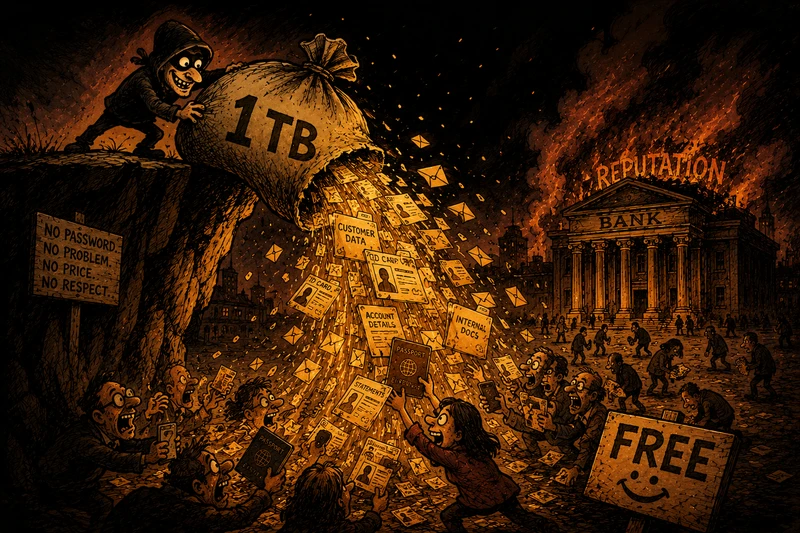
Their playbook is the modern one: double extortion. Classic ransomware encrypts your files and demands payment for the key. Double-extortion crews add a second squeeze – they steal the data first, then threaten to publish it. Even if you have perfect backups and never need their decryption key, they still have your customers’ secrets. Pay, or we leak.
With BoB, TripleX skipped the negotiation entirely and published for free. That’s not charity, it’s reputational maximisation. A free, fully public dump inflicts maximum brand damage and regulatory pressure, which is its own form of leverage and its own kind of advertising for the group’s future victims.
Decoding the attack: how one password becomes one terabyte
Here’s where we slow down and put on the technical hat – gently. You don’t need to be an engineer to follow this. The attack unfolds in a chain, and understanding the chain is the whole point, because every link is a place where the attack could have been stopped.

Link 1 – Initial access: the compromised inbox
TripleX’s own leak-site notes attributed initial access to a weak password on one of the bank’s systems. BoB’s statement points to a compromised employee email account. Put those together and you get a familiar picture: an attacker got valid login credentials for a staff email account.
How does that happen in the real world? Usually one of a few ways:
- Phishing – a convincing fake login page harvests the employee’s username and password.
- Password reuse / weak passwords – the same password used across sites, exposed in an earlier unrelated breach, then replayed here (credential stuffing).
- No multi-factor authentication (MFA), or MFA that could be bypassed or fatigued.
Notice what didn’t happen: no exotic zero-day, no Hollywood-style firewall-melting hack. Just a human, a password, and a gap in identity controls. This is how the overwhelming majority of real breaches begin.
Link 2 – The inbox is a treasure chest

Here’s the uncomfortable truth about corporate email: over months and years, an inbox and its connected cloud drive silently become a document warehouse. KYC forms sent for approval. Loan files forwarded between branches. Audit reports attached to a review thread. Scanned IDs “just for a minute.” None of it was supposed to live there forever, but it did.
So the moment the attacker was inside one trusted account, they didn’t need to break anything else. They simply read, searched, and downloaded – as that employee, with that employee’s permissions. To most security tools, it looked like the employee doing their job.
Link 3 – Lateral movement and privilege
A single mailbox is bad. A single mailbox with access to shared repositories, distribution lists, and cloud storage is far worse. Depending on what that account could reach, the attacker’s blast radius, the total set of data one compromised identity can touch, expands from “one person’s email” to “everything that person, and everyone they could impersonate, had access to.”
This is the quiet multiplier. The leak wasn’t 1 TB because the password was especially weak. It was 1 TB because that one identity had a path to an enormous amount of sensitive data, and nothing flagged the journey from “login” to “mass download.”
⌁ ATTACK PATHS · VISUAL GUIDE The link BoB missed Cloud Security Visualization & Attack Path Analysis Guide Attackers don’t see a list of alerts — they see a path. This guide shows how graph-based visualization exposes the toxic route from one small weakness to your crown-jewel data, so you close it before anyone walks it. See the path →Link 4 – Exfiltration
Finally, the data left the building. Bulk downloads, syncs, or forwards – moving hundreds of thousands of files out to attacker-controlled infrastructure. In a well-instrumented environment, a sudden, anomalous, large-scale data pull is a screaming red flag. In an under-instrumented one, it’s just Tuesday.
⚡ ARCHITECTURE · HOW IT WORKS Catch it the moment it happens Event-Driven Cloud Security Architecture Scheduled scans miss everything that happens between them — and that’s exactly where breaches like BoB’s exfiltration unfold. See why an event-driven architecture reacts the instant a risky change occurs, not hours later. Learn the model →The chain, in one line
Weak identity control → trusted inbox full of sensitive files → an unmonitored path to more data → quiet bulk exfiltration → public leak.
How one password became one terabyte
Click each link to trace how the Bank of Baroda breach unfolded – and where it could have been stopped.
Every serious data breach you read about is some version of this chain. Which is genuinely good news – because a chain can be broken at any link.
How to prevent an attack like this
Let’s turn the attack chain into a defence checklist. We’ll go link by link, because that’s how defenders should think, not “buy one magic box,” but “break the chain in as many places as possible.”
1. Kill the easy initial access (identity first)
- Enforce phishing-resistant MFA everywhere – especially email and any single-sign-on. This one control alone would have made the stolen password far less useful.
- Ban weak and reused passwords with modern policies and breached-password screening.
- Train continuously against phishing – not once a year, but with realistic, ongoing simulations. “Digital hygiene” isn’t a slogan; it’s the front line.
2. Shrink what an inbox can hold and reach
- Don’t let email become a document store. Route KYC, loan, and audit files into governed systems with access controls and expiry, not into inboxes forever.
- Apply least privilege ruthlessly. Every identity should reach only what it truly needs. When a credential is stolen, least privilege is what decides whether the loss is one folder or one terabyte.
3. Map and close the paths before attackers walk them
This is the link defenders most often miss. It’s not enough to secure each asset in isolation; you have to understand how a compromised identity connects to sensitive data across your environment. Attackers think in paths. Defenders must too.
4. Watch for the exfiltration, not just the break-in
- Behavioural analytics (UEBA): learn what “normal” looks like for each identity, so a sudden mass download at 2 a.m. lights up instead of blending in.
- Sensitive-data discovery: know where your crown-jewel data actually lives, including the copies that sprawled into cloud storage and shared drives.
- Fast, rehearsed incident response: BoB’s “immediate containment” only works if the muscle memory exists before the crisis.
5. Assume the cloud is now part of the bank
Modern banking runs on cloud email, cloud storage, and cloud apps as much as on the traditional data centre. The BoB incident is, at its heart, a cloud identity and data problem. Securing the ledger is necessary but no longer sufficient, you also have to secure the sprawling cloud estate where sensitive documents quietly accumulate.
5 ways to break the breach chain
Lock the front door
Enforce phishing-resistant MFA everywhere and ban weak or reused passwords. This one control makes a stolen password almost worthless.
Stops: Initial accessEmpty the inbox
Don’t let email become a document store. Route KYC, loan and audit files into governed systems with access controls and expiry.
Stops: Data hoardingMap the paths
Apply least privilege and use attack-path analysis to see how one identity connects to sensitive data – then close that route.
Stops: Blast radiusWatch the exit
Behavioural analytics (UEBA) learn what normal looks like, so a sudden 2 a.m. mass download lights up instead of blending in.
Stops: ExfiltrationSecure the cloud estate
Modern banking runs on cloud email, storage and apps. A unified CNAPP view removes the seams attackers exploit between tools.
Stops: The whole chainWhere cloud security platforms actually help (the honest version)
Let's be precise, because vague vendor hand-waving helps no one. No platform "un-phishes" an employee. But most of the damage in an incident like this happens after the first password falls - in Links 2, 3, and 4 of the chain. That's exactly the territory a modern cloud-native application protection platform (CNAPP) is built for.
A unified platform like Cy5 ion approaches the problem the way an attacker does - as a graph of connected risk, not a list of isolated alerts:
- Cloud Identity & Entitlement Management (CIEM): finds the over-privileged and dormant identities that turn one stolen credential into a wide blast radius, so least privilege becomes measurable rather than aspirational.
- Graph-based attack-path analysis: stitches together identity, compute, storage, network, and containers into one map, then highlights the toxic path from a compromised identity to sensitive data - the very path that turned one BoB inbox into a terabyte. Seeing the path in advance is how you close it before someone walks it.
- Cloud Security Posture Management (CSPM): catches the exposed storage buckets, misconfigurations, and forgotten sensitive-data stores where copies of KYC and audit files pile up.
- Behavioural detection (UEBA-style): surfaces the anomalous, large-scale data access that signals exfiltration in progress - the moment when a quiet intrusion becomes a loud breach.
The subtle but crucial point: the BoB breach wasn't really about email. It was about what a single trusted identity could reach, and whether anyone was watching the path. That is precisely the question a CNAPP is designed to answer - continuously, across the whole cloud estate, before the answer shows up on a dark-web leak site. Cy5 ion rolls CSPM, CIEM, SIEM, KSPM, vulnerability management, and GRC into one graph-driven view for exactly this reason: attackers exploit the seams between tools, and a unified view removes the seams.
◉ CNAPP · DEEP DIVE Keep Reading CNAPP Correlation Engine: How It Eliminates Cloud Alert Fatigue 4,700 alerts, one real threat. See how ion's graph-based correlation engine fuses misconfigurations, over-privileged identities and network exposure into a single attack story — so your team fixes what matters instead of drowning in noise. Read the breakdown →The regulatory backdrop: this is now a legal event too
The BoB breach isn't only a security story, it's an early real-world test of India's tightening data-protection regime. Under the Digital Personal Data Protection (DPDP) Act, 2023 and the oversight of the Data Protection Board of India, organisations that handle personal data carry real obligations around safeguarding it and notifying authorities when it's breached. CERT-In directions require rapid incident reporting. And the Reserve Bank of India (RBI) holds banks to strict cybersecurity and customer-protection standards.
For banks, the lesson compounds: a breach is no longer just reputational and financial - it's a compliance and disclosure event with regulators watching how quickly and honestly you respond. "We had robust protocols" is a sentence that now gets stress-tested in public.
🏛 BANKING · CISO INSIGHT The bigger picture Cloud Security for Banking Industry: Beyond Compliance to Operational Resilience Ransomware up 78%, breaches averaging $6M, and a perimeter that no longer exists. A CISO's field guide to securing the modern bank — ransomware, misconfigurations, RBI & DPDP compliance, and resilience that outlasts the audit. Read the guide →
What should you do if you bank with BoB?
If you're a customer reading this with a knot in your stomach, here's calm, practical guidance:
- Your money is not the same as your documents. The core banking system reportedly wasn't breached, so this is primarily an identity-and-privacy exposure, not a "your balance is gone" event. Still, treat it seriously.
- Beware targeted scams. Leaked KYC data makes fraudsters very convincing. Expect a rise in phishing calls, SMS, and emails that quote real details about you. A real bank will never ask for your full password, OTP, or PIN. Ever.
- Turn on every security control you have - strong unique passwords, MFA on net-banking, and transaction alerts.
- Monitor your accounts and credit for anything unfamiliar, and report it immediately.
- Watch official channels (BoB, RBI, CERT-In) for guidance rather than acting on messages that arrive out of the blue.
The breach by the numbers
What a single compromised email account exposed - at a glance.
The takeaway
The Bank of Baroda breach is not a story about a genius hacker or an unstoppable weapon. It's a story about a weak password, a trusting inbox, an unmonitored path, and a quiet download - a chain of ordinary failures that added up to an extraordinary leak. That's oddly reassuring, because ordinary failures have known fixes: strong identity controls, least privilege, visibility into attack paths, and eyes on the data.
One password shouldn't be able to become one terabyte. In a well-architected, well-watched cloud environment, it can't. Closing the distance between those two sentences is the entire job of modern cloud security, and the whole point of this breach's very expensive lesson.
Frequently Asked Questions (FAQs)
In late July 2026, roughly 1 TB of Bank of Baroda data - including customer KYC forms, Aadhaar and PAN details, loan files, and internal audit documents was leaked on a dark-web site operated by an extortion group called TripleX. The bank confirmed the cause was a compromised employee email account and said its core banking systems were not accessed.
No. According to the bank's official statement, the core banking system - where accounts and transactions are processed, was not accessed and remains secure. The breach stemmed from a compromised employee email account, exposing documents and data rather than the transactional ledger.
Reports indicate the dataset included an estimated 100,000–300,000 account-opening forms (many with photos and ID documents), Aadhaar and PAN numbers, savings/current/loan account data, net-banking and NRI/corporate records, branch audit reports, loan appraisal files, and internal communications.
TripleX is a relatively new data-extortion group first observed around May 2026, known for a double-extortion model (stealing data and threatening to leak it). It was reportedly behind a 2 TB breach of PT Bank Negara Indonesia before targeting Bank of Baroda.
Through a compromised employee email account. TripleX's leak-site notes attributed initial access to a weak password. Once inside a trusted account, attackers could read and download sensitive files that had accumulated in that inbox and connected storage, no core-system hack required.
Because a single trusted identity often has access to far more sensitive data than it needs. Once attackers control that identity, they inherit its reach. Without least privilege, attack-path visibility, and anomaly detection, a single login can quietly open a path to enormous amounts of data.
Your funds are likely unaffected since the core banking system reportedly wasn't breached, but your personal data may be exposed. Enable MFA on net-banking, use strong unique passwords, watch for scams that quote your real details, never share OTPs or passwords, and monitor your accounts closely.
By breaking the attack chain at every link: enforce phishing-resistant MFA, ban weak/reused passwords, keep sensitive files out of inboxes, apply least privilege, map and close attack paths from identities to data, and deploy behavioural detection to catch bulk exfiltration early. A unified cloud security platform (CNAPP) with CIEM and attack-path analysis addresses the post-compromise stages directly.
Yes. As an incident involving personal data of Indian residents, it falls under the Digital Personal Data Protection Act, 2023, with oversight from the Data Protection Board of India, alongside CERT-In reporting requirements and RBI cybersecurity norms.
It's an attack where criminals both steal data and (traditionally) encrypt systems, then pressure the victim by threatening to leak the stolen data publicly, so even organisations with good backups face a second threat. TripleX used the data-theft-and-leak half of this model against BoB.
Official & primary sources
- Business Standard: Bank of Baroda probes data breach; says core banking systems remain secure: https://www.business-standard.com/companies/news/bank-of-baroda-probes-data-breach-says-core-banking-systems-remain-secure-126072701179_1.html
- Deccan Herald: 1TB of customer details, Aadhaar, phone numbers leaked on darknet: https://www.deccanherald.com/technology/data-breach-in-bank-of-baroda-1tb-of-customer-details-aadhaar-phone-numbers-leaked-on-darknet-4088773
- Business Today: Bank of Baroda hit by cyberattack; 1TB of sensitive data allegedly leaked: https://www.businesstoday.in/technology/news/story/bank-of-baroda-hit-by-cyberattack-1tb-of-sensitive-data-allegedly-leaked-545389-2026-07-27
- BankInfoSecurity: Bank of Baroda Breach Tests Disclosure Readiness: https://www.bankinfosecurity.com/bank-baroda-breach-tests-disclosure-readiness-a-32335
- Reserve Bank of India (regulator): https://www.rbi.org.in
- CERT-In (national incident response authority): https://www.cert-in.org.in
Disclaimer: This article is based on publicly available reporting and official statements as of 28 July 2026. Details of the incident are still emerging and some claims (including the exact data volume) originate from the threat actor's own listing and remain under investigation.