
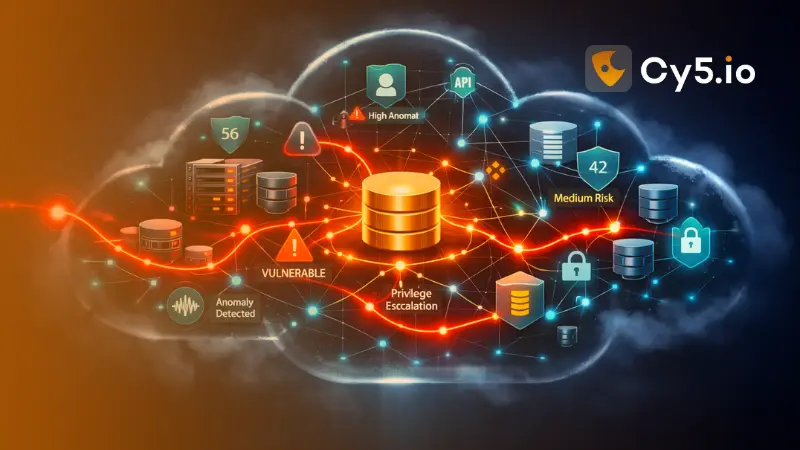
The cloud security landscape has fundamentally transformed. Organizations operating across AWS, Azure, and GCP face an unprecedented challenge: understanding their actual security posture across sprawling, dynamic infrastructure that changes by the minute. Legacy security tools aren’t built for this reality – they generate alerts without context, create detection blind spots between scheduled scans, and leave security teams drowning in false positives while real threats move laterally undetected.
Cloud security visualization and attack path analysis represent the evolution beyond legacy approaches. Rather than examining security configurations in isolation, these methodologies map the interconnected relationships between identities, resources, and permissions across your entire cloud environment. The result? Security teams can finally see what attackers see: the exploitable paths from initial compromise to your most critical assets.
This comprehensive guide examines how cloud security visualization works, why attack path analysis has become essential for enterprise security, and how modern platforms deliver actionable intelligence at cloud speed.
Understanding Cloud Security Visualization: Beyond Traditional Monitoring
Cloud security visualization transforms raw security data into meaningful visual representations that reveal patterns, relationships, and risks across your cloud infrastructure. Unlike traditional monitoring dashboards that display metrics and alerts in tabular formats, visualization approaches create graph-based models that show how resources, identities, and permissions interconnect.
The fundamental challenge driving visualization adoption is complexity. A typical enterprise cloud environment contains thousands of resources; compute instances, storage buckets, databases, serverless functions– each with distinct security configurations, network policies, and access permissions. Traditional point-in-time scanning tools examine these elements individually, but they miss the critical dimension: how these components relate to each other and create exploitable attack paths.
Modern cloud security visualization platforms construct dynamic security graphs that continuously map your cloud topology. These graphs represent resources as nodes and relationships – like network connectivity, IAM permissions, or data flows – as edges. This graph structure enables sophisticated analysis that would be impossible with traditional tabular data.
Consider a seemingly low-risk misconfiguration: an S3 bucket with overly permissive access policies. In isolation, traditional tools might flag this as a medium-severity finding. However, visualization reveals the complete picture: that bucket is accessible by an EC2 instance with a compromised container, which has IAM permissions allowing privilege escalation, which could lead to accessing your entire cloud storage infrastructure. The individual misconfiguration becomes a critical vulnerability when viewed within the context of your complete security topology.
Effective cloud security visualization incorporates several key dimensions.
- Asset visualization maps your complete cloud inventory; compute, storage, network resources, and managed services – showing how these components are organized across accounts, regions, and environments.
- Identity and access visualization illustrates the complex web of IAM roles, service accounts, access keys, and permission boundaries that govern who and what can access your resources.
- Network topology visualization displays VPCs, subnets, security groups, and network access control lists, revealing how traffic flows between resources and where network segmentation exists or fails.
Vulnerability and misconfiguration mapping overlays security findings onto your infrastructure graph, showing which resources have exploitable weaknesses and, critically, which of those weaknesses actually matter based on their position in potential attack paths. Compliance posture visualization demonstrates how your infrastructure aligns with regulatory frameworks and security standards, highlighting gaps and providing audit-ready evidence.
Do Give it a Read: Implementing Cloud Security Posture Management (CSPM) | Cy5 ion Platform
The true power of visualization emerges when these dimensions combine. Security teams can query their environment with questions that were previously unanswerable: “Show me all publicly accessible resources that can reach our production database” or “Which identities have never been used but retain administrative permissions?” These queries execute in seconds against the security graph, delivering answers that would require days of manual investigation using traditional tools.
Real-time visualization becomes essential as cloud environments operate at unprecedented scale and velocity. Infrastructure-as-code deployments can provision hundreds of resources in minutes, developers can spin up new services without centralized approval, and containerized workloads create ephemeral compute instances that exist for hours or minutes. Point-in-time scanning tools that run daily or weekly create dangerous blind spots – attackers can compromise resources, move laterally, and exfiltrate data in the hours between scans.
Event-driven architecture eliminates these blind spots. Modern platforms like Cy5’s ion cloud security platform ingest cloud events in real-time, updating the security graph immediately as infrastructure changes occur. When a developer creates a new S3 bucket, the platform instantly analyzes the bucket’s configuration, evaluates its network accessibility, identifies what IAM principals can access it, and determines whether it creates new attack paths – all before the bucket contains any data. This event-driven approach delivers what traditional tools cannot: security signals at cloud speed, enabling teams to identify and remediate risks as they emerge rather than discovering them hours or days later.
Attack Path Analysis: Thinking Like an Attacker to Defend Like an Expert
Attack path analysis represents a paradigm shift in how organizations approach cloud security. Rather than treating security findings as independent issues to be prioritized by severity scores, attack path analysis examines how an attacker could chain together multiple security weaknesses – individually minor misconfigurations or vulnerabilities – to achieve significant impact like data exfiltration, privilege escalation, or lateral movement to production environments.
The methodology draws from adversarial tactics, techniques, and procedures (TTPs) documented in frameworks like MITRE ATT&CK for Cloud. Security teams map potential attack sequences through their environment, identifying the specific combinations of permissions, network access, and vulnerabilities that would enable an attacker to progress from initial compromise to high-value targets.
Attack paths typically follow a predictable structure despite the unique characteristics of each cloud environment. The initial access phase involves the attacker gaining their first foothold; perhaps through compromised credentials, a publicly exposed service with a known vulnerability, or a misconfigured resource that allows unauthorized access. This entry point may appear innocuous in isolation: a development environment with relaxed security policies, a forgotten test instance with default credentials, or a CI/CD pipeline with excessive permissions.
The privilege escalation phase is where attackers elevate their access rights. Cloud environments present numerous privilege escalation opportunities: IAM roles with permissive AssumeRole policies, service accounts with more permissions than necessary, or container orchestration platforms with weak role-based access controls. An attacker might compromise a low-privilege service account, then use overly permissive IAM policies to assume a role with administrative rights; a single API call that transforms limited access into broad control.
Must Read: Cloud Misconfiguration Detection: Complete Guide for 2026 (AWS, Azure, GCP & Best Practices)
Lateral movement enables attackers to expand their presence across your environment. In cloud contexts, lateral movement often exploits identity-based access rather than network vulnerabilities. An attacker with access to one resource can leverage cloud IAM permissions to access additional resources, move between accounts, or traverse from development to production environments. Overly permissive network security groups compound the problem, allowing compromised resources to communicate with sensitive systems that should be isolated.
Persistence mechanisms ensure attackers maintain access even after initial entry vectors are remediated. In cloud environments, persistence takes many forms: creating new IAM users or access keys, deploying backdoored container images, modifying security policies to allow continued access, or establishing connections to external command-and-control infrastructure through egress network rules.
The impact phase represents the attacker’s ultimate objective: data exfiltration, service disruption, cryptomining using your compute resources, or deploying ransomware. The most sophisticated attacks may remain dormant for extended periods, moving slowly through your environment to avoid detection, gathering intelligence about your infrastructure, and positioning themselves for maximum impact when they choose to act.
Attack path analysis identifies these sequences before attackers exploit them. By modeling how security weaknesses interconnect, organizations can focus remediation efforts on the misconfigurations and vulnerabilities that actually create exploitable paths rather than spending resources on findings that, while technically valid, pose no practical risk given their isolation from critical assets.
Consider a concrete example from a multi-cloud financial services environment. Traditional vulnerability scanning identified several high-severity findings: a publicly accessible S3 bucket in AWS, an Azure virtual machine running an outdated operating system with known CVEs, and a GCP service account with broad permissions across multiple projects. Each finding received a high-severity rating and entered the remediation queue based on CVSS scores.
Attack path analysis revealed a different picture. The publicly accessible S3 bucket contained only marketing materials – publicly available by design – and had no connection to sensitive systems. The Azure VM with outdated software existed in an isolated network segment with restrictive security groups preventing any inbound or outbound communication except with a specific management subnet. The GCP service account with broad permissions had never been used in six months and lacked access keys for authentication.
Meanwhile, the analysis identified a critical attack path that traditional scanning missed entirely: an EC2 instance in a development environment with a medium-severity finding (permissive security group allowing SSH from 0.0.0.0/0) connected to an IAM role with permissions to list and describe production resources. That IAM role included a trust relationship allowing it to assume another role in the production account. The production role had S3 read permissions across all buckets, including those containing customer financial data. An attacker compromising the development EC2 instance – perhaps through credential theft or exploiting a web application vulnerability – could execute a three-step attack path reaching sensitive production data within minutes.
This scenario illustrates attack path analysis’s essential value: contextual risk prioritization. The high-severity findings that topped the traditional remediation queue posed minimal actual risk given their environmental context, while the medium-severity development environment finding represented the most critical vulnerability in the infrastructure. Without attack path analysis, security teams would have allocated resources to remediating isolated high-CVSS findings while the most dangerous attack vector remained unaddressed.
Do Read: Context-Based Prioritization for CSPM: Fix What Actually Reduces Risk
Cy5’s ion cloud security platform delivers attack path analysis that goes beyond theoretical modeling. The platform continuously maps potential attack paths through your cloud environment, using contextual correlation to identify the specific combinations of misconfigurations, permissions, and vulnerabilities that create genuine risk. When a new resource deploys or a permission changes, the platform instantly recalculates affected attack paths, ensuring your security posture assessment remains current as your infrastructure evolves.
This event-driven approach to attack path analysis eliminates the detection blind spots that plague scheduled scanning tools. Traditional CSPM solutions that analyze your environment daily or weekly miss the critical window when new attack paths emerge. A developer might deploy a new service with overly permissive IAM policies at 9 AM, creating an exploitable attack path to production databases. A scheduled scan running at midnight won’t detect this risk until the following day – giving attackers a 15-hour window of opportunity. Event-driven platforms analyze changes as they occur, identifying new attack paths within seconds and enabling immediate remediation before exploitation becomes possible.
Identity-Based Attack Paths: The Cloud’s Most Dangerous Vulnerability Surface
Identity and access management represents the largest attack surface in cloud security, yet it remains one of the least visible and most difficult to secure. Cloud environments operate on an identity-centric security model fundamentally different from traditional network-based perimeters. In the cloud, identities – IAM users, roles, service accounts, and the resources that assume them – control access to data and services. An attacker who compromises an identity effectively bypasses most network-level security controls.
Identity-based attack paths exploit the complex web of permissions, trust relationships, and role assumptions that govern cloud access. These attacks are particularly dangerous because they leverage legitimate cloud functionality – API calls authenticated with valid credentials – making detection extremely difficult. Security tools monitoring for network-based intrusion patterns won’t flag an attacker who’s using properly authenticated API requests to exfiltrate data or escalate privileges.
Must Read: Cloud Security Best Practices for 2026
The challenge begins with IAM complexity. A typical enterprise AWS environment contains hundreds of IAM roles, thousands of policies, and countless trust relationships between services. Azure Active Directory configurations involve intricate role assignments, service principals, and managed identities. GCP uses service accounts with project-level and organization-level permissions that can span multiple cloud projects. Understanding who or what has access to which resources requires analyzing the cumulative effect of policies, group memberships, and permission boundaries – a combinatorial explosion of access paths that grows exponentially with infrastructure scale.
Overprivileged identities create the foundation for most identity-based attacks. Cloud platforms encourage broad initial permissions during development – it’s easier to grant full S3 access than to carefully scope permissions to specific buckets and operations. These overly permissive roles often persist into production, violating least-privilege principles. A compromised service account with s3:* permissions across all buckets in your account can exfiltrate your entire data warehouse. A role with ec2:* can launch instances, modify security groups, and create network pathways to isolated resources.
Identity-based attack paths frequently exploit privilege escalation through IAM role assumption. An attacker who compromises a low-privilege role examines its permission policies, identifies roles it can assume, and leverages sts:AssumeRole calls to gain elevated access. This process can chain across multiple roles: compromise a developer role, assume a deployment role with broader permissions, then assume a production administrator role with full account access. Each assumption represents a valid, authenticated API call – nothing appears anomalous to traditional security monitoring.
Lateral movement in cloud environments often follows identity-based paths rather than network routes. An attacker with access to one AWS account can identify cross-account IAM role trust relationships, assume roles in other accounts, and move across your organization’s cloud boundary. Multi-cloud environments compound this challenge – attackers might compromise an AWS service account with permissions to access GCP through workload identity federation, effectively pivoting between cloud providers using legitimate federation mechanisms.
Toxic combinations represent some of the most dangerous identity-based attack paths. These occur when individually reasonable permissions combine to create severe security risks. Consider an IAM role with two seemingly harmless permissions: iam:PassRole and lambda:CreateFunction. Separately, these permissions appear benign. Together, they enable privilege escalation: an attacker creates a Lambda function, passes it a privileged IAM role using iam:PassRole, invokes the function, and executes code with the privileged role’s permissions – all through authenticated, legitimate API calls.
Another toxic combination involves iam:UpdateAssumeRolePolicy and sts:AssumeRole. With these permissions, an attacker can modify a privileged role’s trust policy to allow their compromised role to assume it, then escalate to administrative access. Traditional security tools scanning for known dangerous permissions might flag iam:* administrative access but miss the specific combination of update and assume permissions that enables the attack path.
Unused and dormant identities expand the attack surface without providing operational value. Access keys created for temporary tasks but never deleted, service accounts provisioned for projects that never launched, or IAM roles created during development and forgotten in production – these identities retain their permissions indefinitely, creating persistent attack paths that organizations often don’t realize exist. An attacker discovering unused credentials in a compromised repository or leaked through misconfigured CI/CD tools gains access through an identity that receives no security monitoring because no one remembers it exists.
Do Give it a Read: Event-Driven Cloud Security Architecture Explained: Design Patterns, Pipeline & Multi-Cloud Security
Multi-factor authentication bypass represents another category of identity-based attacks in cloud environments. While MFA protects console access for human users, many service accounts and programmatic access patterns use long-lived access keys without MFA requirements. An attacker who exfiltrates access keys from a compromised application server or CI/CD pipeline gains authenticated access that bypasses MFA controls entirely.
Addressing identity-based attack paths requires continuous visibility into your IAM configuration and how permissions create exploitable paths. Manual IAM audits cannot keep pace with modern cloud development velocity. Organizations need automated analysis that continuously evaluates IAM policies, identifies overprivileged identities, detects toxic permission combinations, and flags unused credentials that should be revoked.
Cy5’s platform delivers comprehensive identity attack path analysis by correlating IAM permissions with actual resource access patterns and network topology. The platform identifies not just what permissions an identity has, but what it can actually reach given network constraints, whether it has been used recently, and what attack paths it enables. When analyzing a service account with broad S3 permissions, the platform determines which buckets the account can network-access, whether it has MFA enforcement, when it last authenticated, and what privilege escalation paths it enables through role assumption chains.
This contextual analysis transforms identity security from a compliance checkbox into actionable intelligence. Security teams receive prioritized findings focused on identities that create actual attack paths rather than exhaustive lists of every permission deviation from theoretical least-privilege principles. A service account with administrative permissions might seem alarming, but if that account has no access keys, cannot be assumed by any other identity, and exists in an isolated environment with no network path to production, it poses minimal practical risk. Conversely, a role with seemingly limited permissions that can assume a production administrator role through a two-step chain represents a critical vulnerability requiring immediate remediation.
Multi-Cloud Security Analytics: Unified Visibility Across AWS, Azure, and GCP
Enterprise cloud adoption increasingly means multi-cloud adoption. Organizations operate workloads across multiple cloud providers for various strategic reasons: avoiding vendor lock-in, leveraging provider-specific services, maintaining business continuity, or accommodating merger and acquisition integration. This multi-cloud reality creates profound security challenges. Each cloud platform has distinct identity models, networking constructs, security primitives, and API interfaces. Security teams must develop expertise across multiple platforms while maintaining consistent security posture despite fundamentally different underlying architectures.
Multi-cloud security analytics addresses these challenges by providing unified visibility and consistent analysis across heterogeneous cloud environments. Rather than forcing security teams to use AWS Security Hub, Azure Security Center, and GCP Security Command Center as separate tools with incompatible data models, multi-cloud platforms normalize security findings, correlate risks across providers, and identify attack paths that span cloud boundaries.
Do Read: What Is a Man-in-the-Middle Attack (MITM)? Complete Technical Guide
The normalization challenge is substantial. AWS represents compute resources as EC2 instances, Azure as virtual machines, and GCP as compute engine instances – similar concepts with different APIs, metadata structures, and security configuration options. Storage uses S3 buckets in AWS, blob storage in Azure, and cloud storage buckets in GCP – each with distinct permission models. Networking involves VPCs in AWS and GCP but virtual networks in Azure, with different security group and firewall rule constructs across all three.
Effective multi-cloud analytics platforms create abstracted resource models that represent cloud resources in a provider-agnostic way while preserving provider-specific details necessary for remediation. A “compute instance” resource type might represent EC2, Azure VMs, or GCP instances, with common attributes like public IP exposure, security group rules, and IAM permissions mapped to equivalent concepts across providers. This abstraction enables security teams to query their entire multi-cloud environment with unified logic: “Show me all internet-accessible compute instances across all cloud providers” returns comprehensive results without requiring provider-specific queries.
Cross-cloud attack path analysis reveals risks that single-cloud security tools cannot detect. Consider an attacker who compromises an Azure VM in your development environment. That VM has a managed identity with permissions to read secrets from Azure Key Vault. One of those secrets is a service account key for GCP. The GCP service account has permissions to modify Cloud Storage bucket policies. Using the compromised Azure identity to retrieve the GCP credential, the attacker can now modify storage permissions in GCP, creating a cross-cloud attack path that neither Azure-only nor GCP-only security tools would identify because no single tool has visibility across both environments.
Multi-cloud federation compounds attack path complexity. Organizations increasingly use identity federation to enable cross-cloud access – AWS IAM roles that trust Azure AD identities, or GCP service accounts that can assume AWS roles through workload identity federation. These federation paths create legitimate business functionality but also expand the attack surface. An attacker compromising an Azure AD identity might leverage federation to access AWS resources, effectively using Azure as a stepping stone into your AWS environment.
Consistent security policy enforcement across clouds represents another critical challenge. Organizations develop security standards – encryption requirements, network segmentation policies, access control principles – that should apply uniformly regardless of cloud provider. However, implementing these standards requires provider-specific knowledge. Encrypting data at rest uses different mechanisms in S3, Azure Blob Storage, and GCP Cloud Storage. Network segmentation uses security groups in AWS and GCP but network security groups in Azure. Multi-cloud analytics platforms can evaluate compliance with high-level security policies across providers, flagging violations regardless of the underlying implementation differences.
Cy5’s approach to multi-cloud security integrates AWS, Azure, and GCP environments into a single unified security graph. The platform ingests events from all three providers, normalizing them into a common data model while preserving provider-specific attributes. When a resource deploys in any cloud environment, Cy5 immediately analyzes its security configuration, identifies relationships to resources in other clouds, and evaluates whether it creates new attack paths; including paths that span multiple cloud providers.
This unified approach delivers what siloed security tools cannot: comprehensive visibility into your complete multi-cloud attack surface, contextual risk analysis that considers cross-cloud relationships, and prioritized remediation guidance based on actual exploitability across your heterogeneous environment. Security teams operate from a single console rather than context-switching between provider-specific tools, dramatically reducing cognitive load and enabling faster incident response when attacks occur across cloud boundaries.
Graph Security Modeling: The Technology Behind Modern Cloud Security
Graph security modeling represents the technical foundation enabling modern cloud security visualization and attack path analysis. Traditional security data models use relational databases or flat file structures that struggle to represent the complex relationships and multi-hop attack paths characteristic of cloud environments. Graph databases and graph query languages excel at relationship analysis, making them ideal for modeling cloud security topology.
In graph models, entities – resources, identities, policies – become nodes, and relationships – network connectivity, IAM permissions, trust relationships – become edges. This structure naturally represents cloud architecture, where resources relate to each other through multiple dimensions simultaneously. An EC2 instance might have relationships indicating its VPC membership, security group assignments, IAM role attachments, subnet placement, and network connections to databases and storage systems. Graph models represent these multidimensional relationships elegantly, enabling queries that traverse multiple relationship types to identify attack paths.
Graph query languages like Cypher (used by Neo4j) or Gremlin (used by Amazon Neptune and other graph databases) enable sophisticated security analysis with relatively simple queries. Finding attack paths becomes a traversal problem: starting from publicly accessible resources, traverse permission relationships and network connectivity edges to identify paths reaching high-value targets. These queries execute efficiently even across graphs containing millions of nodes and edges, delivering answers in seconds that would require prohibitively expensive joins in relational databases.
The graph model’s power emerges when combining multiple relationship types in a single query. Consider identifying resources vulnerable to a specific attack pattern: “Find all EC2 instances with public IP addresses, running containers with known vulnerabilities, that have IAM roles allowing S3 access to production buckets.” This query traverses network exposure relationships, vulnerability relationships, identity relationships, and resource access relationships simultaneously – analysis that would require complex multi-table joins and application-level processing in traditional data models but executes as a straightforward graph traversal.
Also Read: How to Find and Fix Public S3 Buckets in AWS: 10-Minute Security Audit
Temporal graph analysis adds another dimension by representing how your security posture changes over time. Rather than seeing only current state, temporal graphs maintain historical relationships, enabling queries like “Show me attack paths that existed last week but have been remediated” or “Identify resources whose risk level has increased in the past 24 hours.” This temporal awareness helps security teams understand the effectiveness of their remediation efforts and detect emerging risks as infrastructure evolves.
Machine learning enhances graph-based security analysis in several ways.
- Anomaly detection algorithms identify unusual patterns in the security graph – a new identity with atypical permissions, an unexpected trust relationship between accounts, or a resource configuration that diverges from similar resources.
- Risk scoring models use graph features – node centrality, permission paths, network reachability – to quantify resource risk more accurately than traditional CVSS-based approaches.
- Attack path prediction applies graph neural networks to identify potential attack vectors that haven’t been explicitly modeled, learning from historical attack patterns to anticipate new tactics.
Cy5’s security data lake architecture combines graph modeling with scalable data storage and SQL-friendly querying. The platform maintains a comprehensive security graph representing your complete cloud topology while also providing a serverless data lake where security events and configurations are stored in a queryable format. This dual approach delivers both the relationship analysis power of graph databases and the accessibility of SQL queries familiar to security analysts. Teams can use SQL to generate compliance reports or investigate specific security questions while leveraging graph traversals for attack path analysis.
The serverless architecture ensures the platform scales with your cloud environment without requiring capacity planning or infrastructure management. As your cloud footprint grows from thousands to millions of resources, the security graph scales automatically, maintaining query performance while ingesting the increasing volume of security events that large cloud environments generate. This serverless approach also optimizes cost – you pay only for the analysis you perform rather than maintaining always-on infrastructure sized for peak capacity.
Cloud Misconfiguration Visualization: From Noise to Actionable Intelligence
Cloud misconfigurations represent the overwhelming majority of security incidents. Industry research consistently shows that 95-99% of cloud security breaches involve exploiting misconfigured resources, overly permissive access controls, or preventable vulnerabilities rather than sophisticated zero-day exploits. Despite this reality, security teams struggle with misconfiguration management because traditional tools generate massive volumes of findings without context about which issues actually matter.
Cloud misconfiguration visualization transforms this flood of findings into actionable intelligence by showing not just what is misconfigured, but what impact those misconfigurations enable. Traditional CSPM tools might flag hundreds of high-severity misconfigurations across your environment – publicly accessible storage buckets, overly permissive IAM policies, weak encryption configurations, permissive network security groups. Security teams face impossible prioritization decisions: which of these hundreds of high-severity findings should they remediate first given limited time and resources?
Do Give it a Read: Risk-Based CSPM: The Complete Guide to Contextual Cloud Risk Management
Visualization approaches prioritize misconfigurations based on exploitability in your specific environment. A publicly accessible S3 bucket storing log files in a development account poses different risk than an identically configured bucket storing customer financial data in production. Visualization platforms distinguish these scenarios by analyzing the data classification, environmental context, and attack paths each misconfiguration enables.
Misconfiguration clustering reveals systemic security issues rather than isolated problems. When visualization shows that 80% of your publicly accessible resources belong to a single development team, the root cause becomes clear: that team lacks security training or uses an IaC template with insecure defaults. Rather than remediating hundreds of individual misconfigurations, you can address the systemic issue – update the template, train the team – preventing future misconfigurations rather than just fixing existing ones.
Temporal misconfiguration analysis shows how security posture evolves. After implementing new security policies or deploying security automation, teams want to understand effectiveness. Visualization showing misconfiguration trends over time – the number of publicly accessible resources decreasing, the percentage of encrypted storage increasing – provides concrete evidence that security initiatives are working. Conversely, trending increases in specific misconfiguration categories might indicate new services being deployed without proper security review or developer practices that need adjustment.
Compliance mapping overlays regulatory requirements onto misconfiguration data, showing which findings affect compliance posture. A storage bucket without encryption might violate PCI-DSS requirements if it could potentially store payment card data, but the same misconfiguration might be acceptable for public marketing assets. Visualization platforms map misconfigurations to specific compliance controls, helping teams prioritize remediation for findings that affect audit readiness.
Remediation guidance integration connects misconfiguration visualization to fixes. Rather than just identifying problems, platforms provide specific remediation steps – the exact IAM policy modification needed, the security group rule to adjust, the encryption configuration to enable. Some platforms offer automated remediation where appropriate, automatically fixing certain categories of misconfigurations when they’re detected based on organization-defined policies.
Cy5 reduces misconfiguration noise by 96% in typical deployments through contextual correlation and risk-based prioritization. Rather than alerting on every technical policy deviation, the platform focuses on misconfigurations that create genuine risk given your environmental context. An S3 bucket with public read access might seem alarming, but if it’s designed to serve public content, exists in an isolated account with no connection to sensitive systems, and has been operating this way intentionally for years, it doesn’t require urgent remediation. Cy5’s analysis identifies the misconfigurations that actually matter – those enabling attack paths to critical assets – while filtering out the noise that wastes analyst time on theoretical issues with no practical exploitability.
Also Read: How to Use Graph-Driven Visualization for Threat Hunting | Cy5 CSPM Tool
Real-Time Threat Detection and Response in Cloud Environments
Cloud environments demand real-time threat detection because threats move at cloud speed. An attacker who compromises credentials can exfiltrate terabytes of data in minutes, spin up cryptomining instances that generate thousands of dollars in compute charges within hours, or deploy ransomware across containerized workloads before security teams even know a breach occurred. The detection-to-response window that might span days in traditional environments must shrink to minutes or hours in the cloud.
Real-time detection requires event-driven architecture that analyzes security events as they occur rather than through scheduled batch processing. Cloud providers generate massive event streams – AWS CloudTrail logs every API call, Azure Activity Logs capture all resource modifications, GCP Cloud Audit Logs record administrative actions. Traditional SIEM systems ingest these logs and analyze them in batch jobs that might run every few minutes to every few hours. Event-driven platforms process each event individually as it’s generated, identifying threats in near-real-time.
The volume challenge is substantial. A large enterprise cloud environment might generate millions of security events daily – every API call, resource creation, permission modification, network connection. Processing this volume with sub-second latency requires serverless architecture that scales automatically with event rate. Traditional security tools with fixed processing capacity create bottlenecks, introducing latency that delays threat detection.
Behavioral analytics enhance event-driven detection by identifying anomalous activity that signature-based rules might miss. An attacker using compromised credentials to access S3 buckets appears as legitimate authenticated activity to most security tools. Behavioral analysis detects the anomaly: this IAM role typically accesses a specific set of buckets during business hours, but now it’s accessing unfamiliar buckets at 2 AM and downloading unusually large volumes of data. This deviation from baseline behavior triggers an alert even though every individual action appears legitimate.
Attack path correlation connects detection to context. When an alert fires – unusual API activity, a failed permission attempt, a configuration change – event-driven platforms immediately analyze whether the activity creates or exploits an attack path. An IAM role assuming another role might be routine behavior or might represent privilege escalation in an active attack. Contextual analysis determines which: if the assumed role has elevated permissions and was assumed by a role that rarely performs this action, the risk increases significantly.
Automated response capabilities enable security teams to contain threats before impact occurs. When high-confidence threats are detected – a compromised credential being used to exfiltrate data, a resource deployed with configuration patterns matching known malware infrastructure – automated response can immediately isolate the resource, revoke the credential, or block network traffic, containing the threat while human analysts investigate. This automation is essential given the speed at which cloud attacks progress; waiting for human review before taking action gives attackers the time they need to achieve their objectives.
Integration with SOAR (Security Orchestration, Automation, and Response) platforms extends detection into comprehensive security workflows. When Cy5’s ion cloud security platform detects a threat, it can automatically trigger SOAR playbooks that enrich the alert with additional context, create tickets in security incident management systems, notify relevant teams via Slack or PagerDuty, and initiate containment actions like quarantining instances or revoking API keys.
The integrated SIEM capabilities within platforms like Cy5 eliminate the need for separate security log management systems. Traditional architectures require exporting cloud logs to external SIEM tools, introducing latency, egress costs, and integration complexity. Integrated platforms analyze security events where they’re generated, applying detection logic immediately without the latency of external log shipping. The serverless data lake architecture provides long-term log retention with SQL queryability for investigations and compliance, combining the real-time analysis of SIEM with the scalable storage of data lakes.
Do Check if You Need: Cloud-Native Security Information and Event Management (SIEM) | Cy5
Cloud Risk Prioritization: From Thousands of Findings to Focused Remediation
Security teams operating cloud infrastructure at scale face an overwhelming reality: thousands of security findings flagged by various scanning tools, each technically valid, many marked high or critical severity. Traditional prioritization based on CVSS scores or tool-assigned severity creates a remediation queue that never shrinks – new findings arrive faster than teams can address existing ones, and many high-severity findings pose little actual risk given environmental context.
Effective risk prioritization requires contextual analysis that considers multiple factors: the exploitability of a vulnerability given network topology, the value of data or systems a misconfiguration could expose, the existence of compensating controls that mitigate risk, and the specific attack paths a finding enables or blocks. This multidimensional analysis transforms thousands of findings into a focused list of issues that actually matter.
Environmental context fundamentally changes risk assessment. A critical vulnerability in an internet-facing web server hosting customer applications demands immediate remediation. The identical vulnerability in an isolated development instance with no network path to production and no access to sensitive data has significantly lower actual risk. Traditional tools assign both the same critical severity based solely on the CVE; contextual analysis differentiates them based on their environmental position and potential impact.
Data classification and asset value inform prioritization. A publicly accessible storage bucket containing marketing materials poses minimal risk; the same misconfiguration on a bucket containing customer financial records represents a critical data breach waiting to happen. Understanding what data resides where and how systems are classified enables risk scoring that reflects genuine business impact rather than just technical severity.
Compensating controls reduce effective risk even when technical vulnerabilities exist. A database with a known vulnerability might appear critical in isolation, but if it exists in a private subnet with restrictive security groups allowing access only from specific application servers, and those application servers have their own security controls preventing exploitation, the practical risk decreases substantially. Contextual analysis accounts for these layered defenses.
Attack path enablement represents the most critical prioritization factor. Some findings, while technically valid, exist in isolation with no attack path to valuable assets. Others, even with moderate severity ratings, sit on critical attack paths enabling privilege escalation or lateral movement to sensitive systems. Prioritizing based on attack path position ensures remediation efforts focus on findings that would actually enable or block real attacks.
Remediation complexity affects prioritization decisions. When two findings pose similar risk, teams should prioritize the one with simpler remediation. Adjusting an overly permissive security group rule takes minutes; refactoring an application to eliminate a complex architectural vulnerability might require weeks of development. Factoring remediation effort into prioritization helps teams maximize risk reduction given realistic resource constraints.
Cy5’s risk prioritization engine combines these factors using machine learning models trained on actual security incident data. The platform doesn’t just assign numeric risk scores; it provides contextual explanations of why specific findings matter, what attack paths they enable, and what remediation actions would have the greatest security impact. This transparent prioritization helps security teams make informed decisions and communicate effectively with development teams about why specific remediation work is critical.
The platform also tracks remediation velocity and effectiveness, showing which types of findings your team remediates quickly versus those that languish in the backlog. This data enables process improvements: if certain finding types consistently remain unaddressed, perhaps they need clearer remediation guidance, or perhaps they’re false positives that should be tuned out of your alerts. Understanding your team’s remediation patterns helps optimize the security program for maximum impact.
Also Read: Cloud Threat Detection for Banks: A Real‑Time Cloud Security Monitoring Blueprint for Indian BFSI
Cloud Security Compliance and Governance at Scale
Regulatory compliance and security governance in cloud environments require continuous evidence generation, comprehensive audit trails, and consistent policy enforcement across dynamic, distributed infrastructure. Traditional compliance approaches – quarterly assessments, manual evidence collection, point-in-time audits – cannot keep pace with cloud environments where infrastructure changes continuously and new resources deploy daily or hourly.
Automated compliance monitoring continuously evaluates infrastructure against regulatory frameworks and internal policies. Rather than snapshots taken during audit windows, organizations need real-time compliance posture visibility showing exactly which resources meet or fail to meet specific controls at any moment. When auditors request evidence of compliance with a specific requirement, automated systems can instantly generate comprehensive reports showing current compliance status and historical trends.
Control mapping translates complex regulatory frameworks into specific technical requirements. PCI-DSS requires encryption of cardholder data at rest and in transit; automated mapping identifies all storage systems that might contain payment card information and validates their encryption configurations. HIPAA mandates access controls for protected health information; mapping identifies IAM policies governing access to healthcare data systems and evaluates whether they meet minimum necessary access principles.
Continuous controls monitoring replaces periodic assessments with always-on compliance validation. When a developer deploys a new database, the compliance platform immediately evaluates whether it meets encryption requirements, access control policies, logging standards, and other relevant controls. Violations generate immediate alerts, enabling remediation before audits discover issues and before non-compliant resources accumulate at scale.
Audit evidence automation eliminates manual evidence collection that consumes weeks of security team time before each audit. Compliance platforms maintain comprehensive audit trails – who deployed each resource, when, under what authorization, how configurations changed over time, and what security controls were in place at specific points in time. When auditors request evidence, systems generate detailed reports with supporting documentation in minutes rather than requiring manual evidence gathering over weeks.
Policy as code enables consistent governance at scale. Organizations define security requirements as code – policies specifying encryption requirements, network segmentation rules, IAM permission boundaries, logging standards. These codified policies can be evaluated automatically against every resource, used as guardrails in CI/CD pipelines to prevent non-compliant deployments, and incorporated into infrastructure-as-code templates to build compliance into resources from creation.
Exception management handles the reality that some resources will legitimately deviate from standard policies. Development environments might have relaxed security controls, specific business requirements might necessitate configurations that appear non-compliant, or technical limitations might prevent immediate remediation of certain findings. Compliance platforms provide exception workflows where teams can document legitimate deviations, specify compensating controls, set expiration dates for exceptions, and obtain necessary approvals – maintaining governance without creating brittle inflexibility.
Compliance reporting delivers executive-friendly visibility into security governance. Rather than technical security findings incomprehensible to non-security stakeholders, compliance dashboards show how the organization measures against regulatory frameworks and internal standards, trending over time to demonstrate improvement or highlight emerging risks. These reports provide the evidence that security programs are effective and that compliance investments are working.
Cy5 supports major compliance frameworks including PCI-DSS, HIPAA, SOC 2, ISO 27001, GDPR, and custom internal policies. The platform continuously maps your cloud infrastructure to relevant controls, generates automated compliance reports, and provides remediation guidance for violations. When it’s time for audits, the platform produces comprehensive evidence packages showing current compliance status, historical compliance trends, and detailed documentation of security controls—dramatically reducing the time and effort traditionally required for compliance validation.
Frequently Asked Questions
Cloud security visualization creates graphical maps of your cloud infrastructure showing relationships between resources, identities, permissions, and vulnerabilities. It transforms complex security data into visual models that reveal attack paths and risks invisible in raw configuration data. This approach helps security teams understand their complete attack surface and identify exploitable paths before attackers do.
Attack path analysis maps how attackers could chain multiple security weaknesses together to reach critical assets. Unlike traditional scanning that flags individual vulnerabilities, it shows the complete sequence – from initial compromise through privilege escalation to data access. This reveals which findings actually enable attacks versus those that exist in isolation with no exploitable path.
Identity-based attack paths exploit IAM permissions and trust relationships between cloud identities to escalate privileges. Attackers compromise low-privilege accounts, then use role assumption chains and excessive permissions to gain administrative access – all through legitimate, authenticated API calls that bypass network security controls. These paths are dangerous because they’re difficult to detect with traditional monitoring.
Prioritize based on contextual risk, not just severity scores. Focus on findings that:
–> Enable attack paths to critical assets
–> Affect systems containing sensitive data
–> Lack compensating controls
–> Are exploitable given network topology
Attack path analysis automatically identifies which findings matter by showing what attackers could actually exploit in your specific environment, typically reducing remediation queues by 90-95%.
Graph databases naturally represent cloud security relationships as nodes (resources, identities) and edges (permissions, network connections). They efficiently analyze multi-hop attack paths through graph traversal queries that would require expensive recursive joins in relational databases. This enables finding all possible paths from public resources to sensitive data in seconds, even across millions of resources.
Toxic combinations occur when individually reasonable IAM permissions combine to enable privilege escalation. Examples include:
–> iam:PassRole + lambda:CreateFunction = ability to execute code with privileged roles
–> iam:UpdateAssumeRolePolicy + sts:AssumeRole = ability to grant yourself administrative access
Automated platforms identify these by analyzing permission combinations continuously across all identities.
Real-time, event-driven detection analyzes security events as they occur – identifying threats within seconds instead of waiting for scheduled hourly or daily scans. This enables immediate response before attackers exfiltrate data, deploy cryptominers, or establish persistence. It also detects new attack paths instantly when infrastructure changes, eliminating detection blind spots between scans.
Multi-cloud security provides unified visibility across AWS, Azure, and GCP environments. It’s critical because attacks can span provider boundaries – compromising Azure credentials to access GCP service accounts that modify AWS resources. Single-cloud tools miss these cross-provider attack paths. Multi-cloud platforms normalize security concepts and identify federation-based attack vectors.
Continuous compliance evaluates infrastructure against regulatory frameworks in real-time as resources deploy. When developers create resources, the system immediately validates encryption, access controls, and logging against relevant requirements. This provides always-current compliance status versus outdated quarterly snapshots, and automates audit evidence collection.
–> CSPM (Cloud Security Posture Management): Identifies misconfigurations and compliance violations
–> CNAPP (Cloud Native Application Protection Platform): Comprehensive security across the full cloud-native lifecycle
–> Attack path analysis: Methodology that adds context showing which findings enable actual attack sequences
Attack path analysis enhances both CSPM and CNAPP by prioritizing findings based on exploitability.
Event-driven architecture processes security events individually as they occur, delivering:
–> Sub-minute threat detection instead of hourly/daily scan delays
–> Immediate attack path analysis when infrastructure changes
–> No detection blind spots between scheduled scans
–> Automatic scaling to handle event volume without capacity planning
–> Sophisticated correlation across event sequences
Platforms like Cy5’s ion cloud security use event-driven architecture to deliver security signals at cloud speed.
Key metrics include:
–> Mean time to detect (MTTD) and respond (MTTR) to incidents
–> Number of critical attack paths and remediation velocity
–> Misconfiguration trends showing posture improvement
–> Compliance scores against regulatory frameworks
–> Security coverage percentage across cloud estate
–> Risk scores reflecting actual exploitability, not just vulnerability counts
These demonstrate real risk reduction versus activity metrics.
Balance through automation and guardrails that make secure development the easiest path:
–> Shift-left security: IaC scanning and policy-as-code in CI/CD pipelines
–> Secure-by-default templates: Pre-approved configurations developers can use immediately
–> Fast feedback loops: Immediate notification of security issues with context
–> Automated remediation: Fix common misconfigurations without developer involvement
–> Clear requirements as code: Developers know exactly what passes security validation
Platforms like Cy5 provide policy-as-code guardrails and real-time feedback that guide developers toward secure patterns without slowing velocity.
Machine learning enhances cloud security through:
–> Anomaly detection: Identifies unusual behavior patterns indicating compromise
–> Behavioral profiling: Establishes baselines and flags deviations
–> Risk scoring: Uses graph features to quantify resource risk accurately
–> Attack path prediction: Anticipates novel attack vectors from historical patterns
–> False positive reduction: Distinguishes genuine threats from benign activity
ML becomes essential for analyzing security at scale and identifying patterns humans would miss.
Cy5’s ion cloud security platform delivers:
–> Event-driven architecture: Real-time security signals at cloud speed, not scheduled scanning
–> Unified multi-cloud analysis: Single security graph across AWS, Azure, and GCP
–> Contextual attack path analysis: 96% noise reduction by focusing on exploitable risks
–> Integrated SIEM capabilities: Serverless security data lake with SQL querying
–> Sub-24-hour onboarding: Rapid deployment with immediate value
The platform eliminates detection blind spots and provides actionable intelligence prioritized by actual risk in your specific environment.