
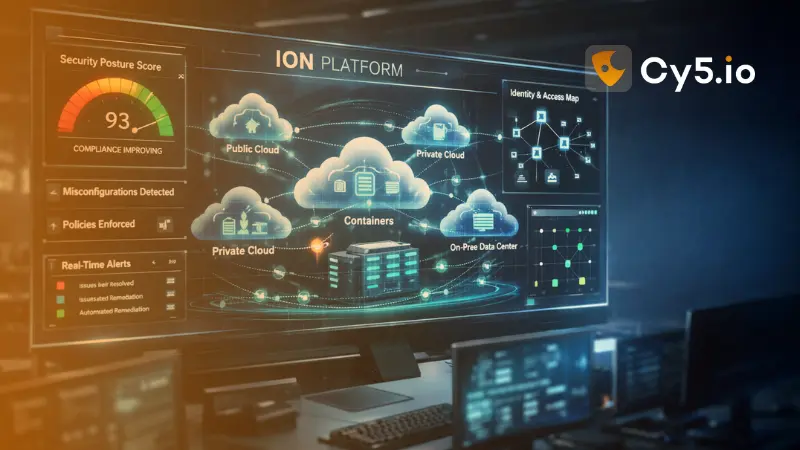
Implementing Cloud Security Posture Management (CSPM) in multi‑cloud and hybrid environments is no longer a “nice to have” – it is the control plane that keeps AWS, Azure, and GCP from turning into a single exploitable blast radius. In this deep guide, we’ll walk through how to design, implement, and scale CSPM across multi‑cloud and hybrid setups, while subtly mapping where a platform like Cy5’s ion cloud security architecture fits into a modern, AI‑driven security program.
Why CSPM Is Non‑Negotiable in Multi‑Cloud and Hybrid
Multi‑cloud and hybrid have become the default architecture for modern enterprises: one cloud for data, another for AI, a third for regional expansion, plus the legacy data center that isn’t going away. Each environment brings its own IAM model, logging format, network primitives, and compliance footprint; and misconfigurations proliferate in that complexity.
- By 2025, 99% of cloud security breaches are projected to be caused by preventable vulnerabilities and misconfigurations, not zero‑days.
- Native tools are powerful but siloed; AWS Config, Azure Policy, and GCP Security Command Center do not natively give you a unified risk narrative across all clouds and on‑prem.
- Boards, regulators, and customers expect continuous evidence of control effectiveness (SOC 2, ISO 27001, RBI, GDPR, HIPAA), not a point‑in‑time audit story.
CSPM solves this by delivering continuous visibility into cloud resources, configurations, and policies, surfacing misconfigurations and compliance gaps before an attacker chains them into a breach. In a multi‑cloud and hybrid context, CSPM becomes the unifying security lens across AWS, Azure, GCP, Kubernetes, and even legacy infrastructure.
What Is CSPM? (And How It Differs from CNAPP, CWPP, SIEM)
Cloud Security Posture Management (CSPM) is a category of security tooling focused on identifying, prioritizing, and helping remediate misconfigurations and policy violations in cloud control planes. Instead of watching packets or EDR events, CSPM inspects the intent encoded in IAM, networking, storage, logging, and encryption settings, and compares it to best practices and compliance frameworks.
Core capabilities of CSPM
A modern CSPM platform typically delivers:
- Continuous resource discovery across AWS, Azure, GCP, Kubernetes, and sometimes on‑prem components exposed to cloud.
- Configuration baseline checks against CIS Benchmarks, NIST, ISO 27001, PCI DSS, RBI and other standards.
- Context‑rich misconfiguration detection (for example, public S3 bucket with sensitive data, internet‑exposed VM with weak security group rules).
- Risk prioritization that considers exploitability, data sensitivity, exposure path, and business context.
- Compliance reporting and evidence mapped to SOC 2, ISO 27001, RBI circulars, GDPR, HIPAA, etc.
- Alerting and/or automated remediation for high‑risk posture issues via playbooks or integration into DevSecOps workflows.
CSPM vs CNAPP vs CWPP vs SIEM
To implement CSPM effectively in multi‑cloud and hybrid environments, it helps to understand what it is not.
| Aspect | CSPM | CNAPP | CWPP | SIEM |
|---|---|---|---|---|
| Primary focus | Cloud configuration and posture | End‑to‑end cloud‑native app security | Workload/runtime protection | Security event aggregation and analytics |
| Scope | Control plane (IAM, network, storage, logging) | CSPM + CWPP + CIEM + DSPM, etc. | VMs, containers, serverless workloads | Logs from apps, endpoints, network, cloud |
| Typical questions | “Is my cloud configured securely?” | “Where is risk across infra, workloads, data?” | “Is this workload under attack now?” | “What happened, where, and when?” |
| Output | Misconfigurations, compliance gaps | Unified risk view, prioritized attack paths | Runtime alerts, exploit attempts | Correlated security incidents |
| Relationship | Core CNAPP component | Superset that includes CSPM | Often integrated into CNAPP | Often consumes CSPM findings for context |
In practice, many enterprises start with CSPM, then converge into CNAPP as they consolidate workload and data security under a single platform.
Do Give it a Read: Ransomware Attacks on Public Cloud Infrastructure: The 2026 Defense Blueprint for AWS, Azure, and GCP
Why Multi‑Cloud and Hybrid Make CSPM Harder (and More Critical)
Running CSPM in a single cloud is challenging; doing it across AWS, Azure, GCP and on‑prem adds orders of magnitude more complexity.
Complexity drivers in multi‑cloud and hybrid
- Inconsistent IAM models
- AWS IAM policies vs Azure RBAC vs GCP IAM roles mean “admin” is encoded differently in each platform.
- Fragmented logging and telemetry
- CloudTrail vs Azure Activity Logs vs GCP Audit Logs vs on‑prem SIEM all speak different dialects.
- Divergent network models
- Security Groups, NSGs, Firewall Rules, VPC peering, Private Links, VPNs and mesh overlays create opaque connectivity patterns.
- Different native security services
- AWS Config, Azure Defender for Cloud, and GCP SCC each offer partial posture coverage, but none become the unified view across all environments.
- Hybrid dependencies
- Legacy applications in data centers exposed via VPNs or direct connect to cloud resources extend the blast radius of a single misconfiguration.
Without CSPM, teams are forced into manual spreadsheet audits, ad‑hoc CLI scripts, and reactive incident handling – essentially, posture by “best effort.” With CSPM, posture management becomes systematic, continuous, and measurable across all environments.
The risk reality: 10 minutes to exploit
Attackers don’t wait for your next scheduled scan. In many cloud compromise simulations, exposed credentials, overly permissive IAM roles, or public storage buckets are discovered and exploited in under 10 minutes. That’s why periodic posture scans (for example, daily or weekly) leave a structural detection blind spot that adversaries actively exploit.
Event‑driven architectures – where changes in cloud resources trigger immediate evaluation and correlation – drastically reduce that window of exposure, especially when integrated with a security data lake and SIEM‑grade analytics.
A Reference Architecture for CSPM in AWS, Azure, GCP, and Hybrid
Before implementing CSPM, it helps to design a target architecture that aligns with your existing cloud footprint and your operating model (centralized security team vs federated, regional vs global).
Core architectural principles
- Centralized visibility, decentralized ownership
- One CSPM control plane with per‑account / per‑subscription ownership retained by individual teams.
- Event‑driven posture evaluation
- Cloud configuration changes (for example, new S3 bucket, updated NSG rule) trigger near real‑time checks instead of waiting for batch jobs.
- Security data lake as the backbone:
- Normalize posture findings, identity context, and network indicators into a serverless, SQL‑queryable data lake to support advanced analytics and machine learning.
- Tight SIEM / SOAR integration:
- High‑risk posture deviations become actionable incidents with playbooks for triage, enrichment, and remediation.
Multi‑cloud CSPM architecture at a glance
A typical architecture looks like this:
- Cloud connectors and discovery layer
- Read‑only integration into AWS, Azure, GCP via cloud‑native APIs, with organizational/management group coverage to avoid “orphan” accounts.
- Discovery across compute (EC2, VM Scale Sets, GCE), storage (S3, Blob, GCS), identity, KMS, container registries, serverless, and managed services.
- Configuration and compliance engine
- Policy engine that codifies CIS Benchmarks, NIST, ISO 27001, RBI, SOC 2, and custom standards into machine‑readable rules.
- Environment‑aware checks to avoid generic noise (for example, internet‑exposed resource plus sensitive data plus missing MFA).
- Contextual correlation and risk scoring
- Graph or rules‑based correlation to detect “toxic combinations”: publicly exposed compute, permissive firewall rules, broad IAM, and full access to storage or IAM itself.
- Business context (tags, accounts mapped to business units, critical workloads) used in risk scoring.
- Security data lake + analytics
- Posture findings, events, and identity usage patterns ingested into a serverless data lake with delete protection, versioning, and distributed storage.
- Analysts can query posture trends, misconfiguration root causes, and identity anomalies using familiar SQL.
- Remediation and DevSecOps integration
- Integrations into CI/CD pipelines, GitOps workflows, and ITSM platforms for ticketing and approvals.
- Automated remediation for low‑risk, high‑volume posture issues (for example, enabling encryption, fixing logging, tightening SGs) under change‑management guardrails.
A platform like Cy5’s ion cloud security, with its event‑driven architecture, contextual correlation layer, serverless security lake, and integrated SIEM engine, is purpose‑built to deliver this model end‑to‑end without forcing you into vendor lock‑in on any specific cloud.
Step‑by‑Step: How to Implement CSPM in Multi‑Cloud and Hybrid Environments
Step 1: Establish your CSPM vision, scope, and success metrics
Before touching tools, define why you are implementing CSPM and what “success” looks like.
- Scope
- Clouds: AWS, Azure, GCP, plus any colocation or private cloud that interacts with them.
- Accounts/projects: Start with production and shared services; expand to dev/stage later.
- Assets: Compute, containers, storage, databases, IAM, key management, APIs, serverless, Kubernetes clusters.
- Stakeholders
- CISO and security leadership for strategy and risk appetite.
- Cloud security architects and DevSecOps leads for design and integrations.
- Platform/DevOps teams for implementation and guardrails.
- Compliance and internal audit for control mapping and evidence.
- Success metrics (examples)
- X% reduction in critical and high‑risk misconfigurations in 6 months.
- Y% reduction in mean time to detect (MTTD) posture drift.
- Continuous SOC 2 / ISO 27001 evidence for cloud controls without manual data collection.
Step 2: Build a unified cloud asset and identity inventory
You cannot protect what you cannot see. An accurate, continuously updated inventory is the foundation of CSPM.
- Connect to all cloud providers using organization‑level connectors wherever possible to avoid missing accounts or subscriptions.
- Normalize resource metadata (tags, labels, regions, resource types) so an S3 bucket and Azure Blob can sit in the same logical category for policies.
- Enumerate identities and entitlements across IAM users, roles, service principals, managed identities, and groups — including machine identities used by applications and CI/CD pipelines.
Platforms that already leverage hybrid ingest – from cloud‑native sources, vendor‑specific logs, and custom resources – give you a head start here, since they can plug into existing data sources rather than adding new agents everywhere.
Step 3: Define your cloud security baseline and governance framework
This step translates your security policy and compliance requirements into implementable CSPM policies.
- Start from industry benchmarks
- CIS Benchmarks for AWS, Azure, GCP, Kubernetes.
- NIST, ISO 27001 Annex A controls, RBI cybersecurity guidelines, SOC 2, HIPAA, GDPR as applicable.
- Layer on business‑specific policies
- Data localization requirements for Indian workloads (RBI, CERT‑IN guidance, sector‑specific circulars).
- Environment‑specific tolerances (for example, dev may allow broader outbound access than production).
- Codify guardrails as policy‑as‑code where possible
- For example, using OPA/Rego, Terraform policies, or cloud‑native policy engines that tie into your CSPM platform.
CSPM tools turn these frameworks into automated checks and alerts; more advanced platforms can even map specific policies to remediation playbooks and risk scores.
Step 4: Configure CSPM for AWS, Azure, and GCP
Each cloud requires specific integrations and best practices.
CSPM in AWS
Key focus areas:
- Enforce multi‑factor authentication (MFA) on root accounts and critical IAM roles.
- Ensure S3 buckets and EBS volumes with sensitive data are encrypted and not publicly exposed without justification.
- Restrict Security Groups to least privilege, avoiding 0.0.0.0/0 on sensitive ports.
- Enable CloudTrail, Config, GuardDuty, and centralize logs to dedicated accounts.
CSPM policies should continuously check these configurations and correlate them with IAM and network context to separate “theoretical” risk from live, exploitable paths.
CSPM in Azure
Key focus areas:
- Enforce Azure AD Conditional Access and MFA for privileged roles.
- Harden NSGs and Azure Firewall policies to avoid overly permissive inbound rules.
- Ensure Storage Accounts, SQL, and managed services enforce encryption, logging, and private endpoints where required.
- Enable Microsoft Defender for Cloud and integrate its signals into your CSPM engine for unified visibility.
4.3 CSPM in GCP
Key focus areas
- Lock down IAM roles and service accounts to least privilege.
- Harden firewall rules and VPC networks, especially between projects and on‑prem.
- Ensure Cloud Storage, BigQuery, and other data services enforce encryption, logging, and restricted access.
- Leverage Security Command Center’s findings as an input to your broader CSPM posture.
Your CSPM strategy should treat each cloud’s native tooling as signal sources feeding into a broader, multi‑cloud posture view, rather than as competing consoles.
Step 5: Extend CSPM to hybrid and Kubernetes environments
Most enterprises now run critical workloads in Kubernetes and on‑prem infrastructure connected to cloud.
- Kubernetes Security Posture Management (KSPM)
- Read‑only cluster integration, scanning K8s API, RBAC, network policies, pod security, and API server configuration.
- Typical posture checks: containers allowing arbitrary command execution, privileged pods, insecure API server ports, permissive roles, and CoreDNS modification rights.
- Hybrid posture
- VPNs, Direct Connect/ExpressRoute, and SD‑WAN links must be modeled as part of your attack surface, not as “trusted pipes.”
- On‑prem resources exposed to the internet or bridging into cloud should appear in CSPM dashboards for visibility and governance.
Platforms that embed KSPM into the broader CSPM engine enable you to view Kubernetes risks next to IAM, network, and data posture – not in yet another silo.
Also Read: Entity-Driven Cloud Security Architecture: The Future of Contextual Threat Protection
Step 6: Enable contextual correlation to find “toxic combinations”
Misconfigurations rarely exist in isolation; breaches happen when multiple small weaknesses combine into an attack path.
A mature CSPM deployment should detect patterns like:
- Public network access (0.0.0.0/0) → overly permissive compute → full access to storage and IAM.
- Broad IAM permissions granted but barely used, on identities with access keys, no MFA, and dormant activity.
- Vulnerable container images exposed via internet‑facing services in clusters with weak network policies.
This is where a contextual correlation layer – like ion cloud security’s correlation engine — becomes critical, since it can combine identity, network, and workload context into a unified posture story rather than a flood of isolated alerts.
Step 7: Integrate CSPM with SIEM, SOAR, and incident response
CSPM without operationalization becomes a “beautiful dashboard” that nobody has time to fix.
- SIEM integration
- Stream CSPM findings into your SIEM with normalized JSON structures, so posture issues appear alongside endpoint, network, and application events.
- Use correlation rules to highlight when posture issues are being actively probed (for example, public bucket plus suspicious access logs).
- SOAR and automation
- Attach playbooks to common misconfigurations (for example, auto‑tagging, tightening security groups, enabling logging) with human‑in‑the‑loop approvals.
- Provide context (business unit, environment, data criticality) to responders so they can prioritize effectively.
ion’s integrated SIEM engine and security data lake are designed to compress this loop by combining real‑time ingestion, correlation, and remediation triggers within a single architecture, helping teams move from reactive posture management to proactive risk reduction.
Step 8: Embed CSPM into DevSecOps and “shift left”
To avoid posture becoming a constant firefight, CSPM needs to move earlier into the software delivery lifecycle.
- Policy-as-code in CI/CD
- Apply CSPM policies to IaC templates (Terraform, CloudFormation, ARM/Bicep, Helm) before they are deployed.
- Pre‑deployment checks
- Integrate CSPM checks into pipelines with gating rules that prevent high‑risk misconfigurations from reaching production.
- Developer feedback loops
- Provide human‑readable explanations and fix‑guides in pull requests and build logs, not just in security consoles.
When CSPM shifts left, cloud misconfigurations become rare exceptions instead of a constant operational burden – and your security team recovers critical time for higher‑order threat hunting and incident response.
Step 9: Measure, communicate, and continuously improve
CSPM is not a one‑time project; it is a continuous program.
- Metrics to track
- Volume and trend of critical/high misconfigurations by environment and business unit.
- Mean time to detect and remediate posture issues (MTTD/MTTR).
- Audit findings against SOC 2, ISO 27001, RBI, HIPAA, GDPR, etc.
- Communicating impact
- Translate posture metrics into business language: reduced breach likelihood, improved compliance readiness, lowered operational overhead, and lower total cost of ownership.
- Share case studies of noise reduction and accelerated onboarding to show CSPM’s impact beyond security.
A platform with strong reporting and analytics – especially one backed by a security data lake and machine‑learning analytics – turns CSPM into a strategic asset for the boardroom, not just an engineering utility.
Read: Misconfigured AWS S3 Buckets: The Definitive 2026 Guide to Risks, Detection, and Prevention
Compliance‑Driven CSPM for SOC 2, ISO 27001, RBI, GDPR, HIPAA
Compliance is often the forcing function for CSPM adoption, especially in regulated sectors like fintech, banking, healthcare, and SaaS.
CSPM for SOC 2 and ISO 27001
SOC 2 and ISO 27001 both require demonstrable controls over access management, change management, monitoring, logging, and incident response.
- CSPM continuously validates whether cloud configurations align with documented policies (for example, logging on, encryption enforced, least privilege access).
- It produces evidence – timestamps, resource IDs, policy references – that auditors can test without requiring manual screenshots or one‑off scripts.
CSPM for RBI and India‑specific regulations
For Indian BFSI and fintech, RBI and CERT‑IN add another layer of expectations around data localization, logging, and third‑party risk.
- CSPM can flag non‑compliant data residency patterns (for example, regulated data stored outside approved regions).
- It can continuously validate encryption, key management, and network segmentation for systems in scope for RBI guidelines.
CSPM for GDPR and HIPAA
GDPR and HIPAA demand strict controls on personal and health information, including data minimization, access controls, and breach notification.
- CSPM helps ensure that storage services, backups, and data flows follow expected policies (for example, encryption, access logging, limited access).
- When paired with data classification, CSPM can prioritize misconfigurations involving regulated data over generic technical findings.
ion’s security data lake, contextual correlation, and automated reporting have been used by sectors like fintech, telecom, and ed‑tech to reduce noise by over 85–96% while still meeting aggressive regulatory timelines – a model that translates well to BFSI, SaaS, and healthcare.
Do Give it a Read: Risk-Based CSPM: The Complete Guide to Contextual Cloud Risk Management
AI‑Driven CSPM: Machine Learning, Autonomous Remediation, and Future Trends
AI and machine learning are rapidly transforming how CSPM identifies and prioritizes risk, particularly in noisy multi‑cloud estates.
Machine learning in CSPM
Machine learning models can:
- Learn normal patterns of identity, network, and resource usage across accounts and regions.
- Flag anomalous changes that deviate from typical posture drift, such as sudden broadening of IAM permissions or unusual exposure of critical resources.
- Cluster misconfigurations into themes and root causes, helping teams fix the underlying patterns rather than treating symptoms.
When backed by a security data lake and big‑data‑ready analytics stack, these models enable risk scoring that mirrors real attacker behavior rather than simplistic severity labels.
AI‑driven remediation and recommendations
AI is increasingly used to generate remediation recommendations in the language that operators understand – Terraform snippets, CLI commands, or policy updates.
- For common issues, AI can propose one‑click remediations that conform to your policy‑as‑code and change‑management process.
- For complex issues, it can explain trade‑offs (for example, security vs availability) so engineers can make informed decisions.
Platforms like ion that combine machine learning analytics with serverless security lakes and SIEM‑class correlation are uniquely positioned to offer this “autonomous” posture improvement experience without sacrificing human oversight.
Best Practices and Checklists for Multi‑Cloud CSPM Success
To consolidate the implementation guidance into something you can execute, use the following checklists as planning templates and talking points for your internal stakeholders.
Executive‑level CSPM checklist
- Defined risk appetite and target posture for each environment (prod, non‑prod).
- Mapped regulatory landscape (SOC 2, ISO 27001, RBI, GDPR, HIPAA) to specific cloud controls.
- Selected CSPM platform with proven multi‑cloud support and integration into existing SIEM/SOAR.
- Established governance model (who owns what) and escalation paths for critical misconfigurations.
Technical implementation checklist
- All AWS, Azure, GCP accounts on‑boarded via organization‑level connectors.
- Baselines configured using CIS, NIST, ISO, RBI, and custom policies.
- KSPM enabled for all critical Kubernetes clusters.
- Identity posture in place (unused access keys, over‑privileged roles, missing MFA flagged).
- Event‑driven posture evaluation configured (no reliance on batch scans alone).
- CSPM integrated with SIEM and SOAR for triage and automated remediation.
Operational excellence checklist
- Monthly posture reviews with trend analysis and action plans per business unit.
- Quarterly refinement of policies and thresholds to align with evolving architecture and threats.
- DevSecOps training to ensure developers understand posture implications of their IaC changes.
- Periodic red‑teaming or breach‑and‑attack simulations to validate CSPM coverage.
Cy5’s customers in telecom, fintech, and other sectors have used similar patterns to reduce mean time to detect by 97%, cut noise by up to 96%, and onboard new environments in under 24 hours – translating posture improvements into tangible operational savings.
Subtle But Strategic Ways to Evaluate CSPM Platforms (and Where ion Fits)
When shortlisting CSPM tools for multi‑cloud and hybrid environments, focus less on feature checklists and more on how each platform will change your team’s day‑to‑day reality.
Evaluation dimensions
- Multi‑cloud depth, not just breadth
- Does the platform offer deep, cloud‑native coverage for AWS, Azure, and GCP (including managed services and Kubernetes), or just shallow API checks?
- Real‑time vs scheduled detection
- Can it evaluate changes as they happen, or is it limited to 1–24‑hour scan windows that leave you exposed?
- Contextual correlation
- Does it reveal toxic combinations across identity, network, and storage, or only surface isolated misconfigurations?
- Data lake and analytics maturity
- Can your analysts run ad‑hoc investigations using SQL, visualize posture trends, and feed ML models without building infrastructure from scratch?
- Noise reduction and actionability
- Are alerts deduplicated, prioritized, and enriched, or will your team need another tool just to handle the noise?
- Compliance and reporting
- Does the platform provide ready‑to‑use reports for SOC 2, ISO 27001, RBI, HIPAA, GDPR, etc., with the ability to customize for your internal control library?
How ion cloud security aligns with a modern CSPM strategy
While this article is vendor‑neutral in its guidance, the architecture you’ve seen – event‑driven posture evaluation, contextual correlation, security data lake, integrated SIEM, KSPM, and analytics – is precisely the model ion cloud security was designed to serve.
- Event‑driven architecture minimizes detection blind spots by evaluating configuration changes as they occur across AWS, Azure, and GCP.
- Contextual correlation reveals toxic combinations that map closely to real attacker behavior rather than superficial risk scores.
- Hybrid ingest, a serverless security data lake, and integrated SIEM engine simplify your stack while giving you big‑data‑grade analytics without operational overhead.
- Proven outcomes – such as 97% reduction in MTTD, 85–96% noise reduction, and consistent impact across fintech, telecom, ed‑tech, and other sectors – demonstrate that posture management can be both rigorous and business‑friendly.
Must Read: Context-Based Prioritization for CSPM: Fix What Actually Reduces Risk
For organizations serious about implementing CSPM in multi‑cloud and hybrid environments, platforms that combine these traits effectively become a force multiplier for small and large security teams alike.
FAQs on CSPM in Multi‑Cloud and Hybrid Environments
Cloud Security Posture Management (CSPM) is a set of tools and practices that continuously monitor cloud environments for misconfigurations, policy violations, and compliance gaps. Its core benefits include improved visibility across assets, reduced breach risk by fixing misconfigurations early, continuous compliance evidence, and faster incident response through better context.
Multi‑cloud and hybrid setups introduce inconsistent IAM models, fragmented logging, and complex network paths that make manual posture management nearly impossible. CSPM consolidates visibility, standardizes policies, and applies consistent checks across AWS, Azure, GCP, Kubernetes, and on‑prem systems, dramatically reducing blind spots.
Begin by connecting all cloud accounts and subscriptions into a unified CSPM platform, then build an accurate asset and identity inventory. Next, apply CIS, NIST, ISO 27001, RBI, and other relevant frameworks as baseline policies, and tune them for your environment before expanding into automation and DevSecOps integration.
CSPM typically forwards findings as normalized events to SIEM platforms, where they can be correlated with logs from endpoints, applications, networks, and identity providers. SOAR tools then attach playbooks to specific posture issues, enabling automated or semi‑automated remediation while preserving approvals and audit trails.
Yes, CSPM can continuously check whether cloud configurations align with controls related to access management, logging, encryption, network security, and incident response. It also generates evidence – such as historical configuration states and remediation timelines – that auditors can test to validate control effectiveness.
CSPM tools use cloud APIs to inspect configurations for resources like virtual machines, storage, databases, networks, and IAM entities. They compare this data against policy rules derived from benchmarks and your own security standards, flagging deviations as misconfigurations or policy violations.
CSPM focuses on cloud posture: how resources are configured and whether they comply with policies and standards. SIEM focuses on events and logs across many domains (endpoints, applications, networks, cloud) to detect active threats and attacks.
CSPM focuses on configuration and compliance of cloud infrastructure, while CNAPP combines CSPM, CWPP, CIEM, and data security to give broader coverage across workloads and applications. CWPP focuses specifically on protecting workloads (VMs, containers, serverless) at runtime through behavioral monitoring, integrity checks, and exploit prevention.
Look for comprehensive multi‑cloud coverage, event‑driven detection, strong identity and network context, compliance mapping, integration with SIEM/SOAR, and support for KSPM. Also prioritize noise reduction, flexible policy definitions, and a security data lake or equivalent analytics capability.
For Indian organizations, CSPM helps enforce data localization constraints, encryption requirements, and secure connectivity to regulated systems. It also supports continuous monitoring and reporting demanded by RBI and sector‑specific regulators, cutting down manual effort during audits.
CSPM can be integrated into CI/CD pipelines and Git‑based workflows to evaluate infrastructure‑as‑code templates before deployment. This allows teams to prevent misconfigurations from ever reaching production while providing developers with actionable feedback during code review.
AI models can learn normal patterns of cloud usage and identity behavior to detect anomalous posture changes, cluster misconfigurations into root‑cause themes, and suggest remediation steps tailored to your environment. When combined with a security data lake, this enables more accurate risk scoring and reduced alert fatigue.
ROI is typically measured via reductions in high‑risk misconfigurations, faster detection and remediation times, reduced audit preparation effort, and avoided breach costs. Additional benefits include lower tool sprawl when CSPM is integrated with SIEM and CNAPP capabilities, and improved developer productivity through automated guardrails.
Do Give it a Read: How Attackers Exploit Cloud Storage Misconfigurations: Real Breaches, Attack Techniques & Prevention Strategies
Yes, CSPM evaluates the configuration of serverless services and container orchestrators (such as Kubernetes), including identity permissions, network exposure, logging, and runtime guardrails. For full runtime protection, CSPM is often complemented with CWPP or CNAPP capabilities that specialize in workload‑level defenses.
ion cloud security is particularly relevant when you want to combine CSPM, correlation, SIEM‑class analytics, and KSPM under an event‑driven, serverless architecture. It is suited for organizations that need multi‑cloud posture management, reduced alert noise, and faster incident response without assembling and operating a complex DIY analytics stack.
By treating CSPM not just as a tool purchase but as a continuous, data‑driven program anchored in multi‑cloud and hybrid realities, you can move from reactive misconfiguration firefighting to proactive, AI‑assisted risk management – and platforms aligned with this architecture, such as ion cloud security, can accelerate that journey while keeping your teams focused on what matters most.