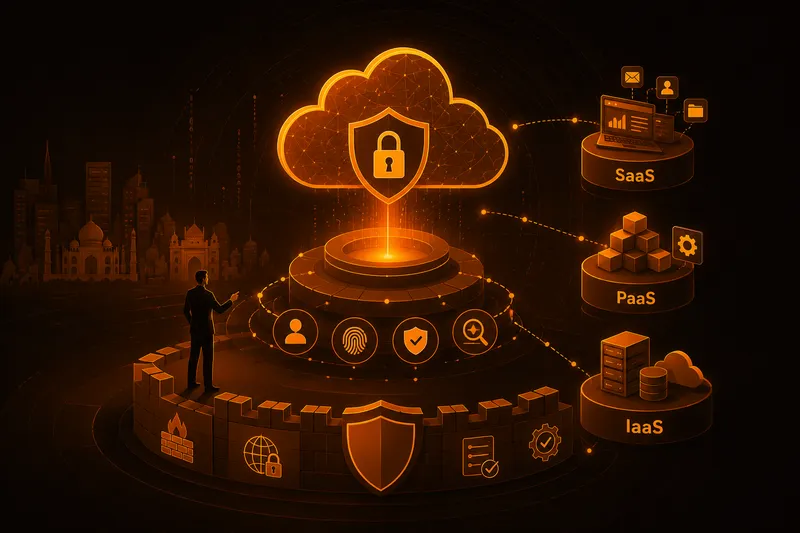

Cloud computing security architecture is the structured set of controls, trust boundaries, and responsibilities that protects identities, workloads, data, networks, and the control plane across a cloud environment. What makes it genuinely difficult isn’t the list of controls – it’s that the architecture changes shape depending on how you consume the cloud. Securing a fleet of virtual machines is a different job from securing a managed database, which is a different job again from securing a SaaS application your finance team logs into. Get the model wrong, and you’ll defend a layer the provider already owns while leaving your own doors open.
This guide takes a deliberately practical cut at the topic: we look at cloud security architecture through the lens of the service model – Infrastructure as a Service (IaaS), Platform as a Service (PaaS), and Software as a Service (SaaS) – and then extend it to the reality most enterprises actually live in: hybrid and multi-cloud, now with AI workloads layered on top. If you want the broader treatment of frameworks and layers, our cloud security architecture pillar guide covers that ground. Here, we’re answering a sharper question: what does secure architecture look like for each way you buy the cloud, and who is responsible for what?
A quick note on why this matters right now. Gartner has projected that through 2026, 99% of cloud security failures will be the customer’s fault – overwhelmingly misconfiguration, not provider compromise. Roughly 82% of those misconfigurations trace back to human error, and the Cloud Security Alliance ranks misconfiguration as the single biggest threat to cloud computing. The uncomfortable truth is that almost every one of those failures happens on the customer’s side of a line most teams have never clearly drawn. Service-model architecture is how you draw that line, and then defend it.
What is cloud computing security architecture?
Cloud computing security architecture is the blueprint that defines how you protect the five things every cloud environment contains – identities, workloads, data, networks, and the control plane, and how security responsibility is divided between you and your cloud provider. It translates abstract principles like “least privilege” and “defense in depth” into concrete enforcement points: where authentication happens, which traffic is allowed to cross which boundary, how data is encrypted and monitored, and who is accountable when something drifts out of policy.
A useful way to picture it is as a stack of layers, each of which needs its own controls:
- Identity and access – who and what can authenticate, and what they’re allowed to do (human users, service accounts, machine and AI identities).
- Network and perimeter – segmentation, private connectivity, ingress/egress control, and the shift away from a fixed perimeter toward identity-based access.
- Workload and compute – hardening, patching, runtime protection, and image/container security for whatever is actually executing your code.
- Data – classification, encryption in transit and at rest, key management, and data-loss prevention.
- Control plane and posture – the configuration of the cloud services themselves, continuously checked against a known-good baseline.
- Detection, response, and governance – telemetry, threat detection, compliance mapping, and the operational muscle to act on what you find.
The layers are constant. What shifts – and this is the whole point of a service-model view – is how much of each layer you own versus how much your provider handles for you. That division is governed by the shared responsibility model, and it’s where we need to start.
The shared responsibility model: the spine of service-model architecture
The shared responsibility model is the framework that establishes which security tasks belong to the cloud provider, and which belong to you, the customer. Every major provider – AWS, Microsoft Azure, and Google Cloud – publishes its own version, and while the wording differs, the core logic is identical: the provider secures the cloud; you secure what you put in it. The exact boundary slides depending on the service model. The more managed the service, the more the provider takes on, but there are a few things that never leave your plate.
Here is the split translated into practical ownership:
| Layer | On-prem (for contrast) | IaaS | PaaS | SaaS |
|---|---|---|---|---|
| Data & data governance | Customer | Customer | Customer | Customer |
| Identity & access management | Customer | Customer | Customer | Customer |
| Application / code | Customer | Customer | Customer | Provider |
| Operating system, network config, firewall | Customer | Customer | Provider | Provider |
| Virtualization / hypervisor | Customer | Provider | Provider | Provider |
| Physical hosts, network, data center | Customer | Provider | Provider | Provider |
Read that tabletop to bottom and one pattern jumps out. Data, identity, and configuration stay with the customer in every single model. You can outsource the servers, the runtime, even the entire application – but you can never fully outsource who gets in and what they can reach once they’re there. That’s why identity has quietly become the real perimeter of cloud security, and why so many breaches begin not with a kernel exploit but with an over-permissioned role or a public storage bucket that should have been private.
There’s a 2026 caveat worth stating plainly: the shared responsibility model was designed for a simpler cloud. With distributed systems, serverless functions, multi-cloud sprawl, and now AI pipelines, the boundaries have become fluid rather than crisp. Security teams routinely misjudge where the provider’s job ends and theirs begins and that seam, the place where each side assumes the other has it covered, is exactly where misconfiguration risk concentrates. A service-model architecture doesn’t just accept the model; it makes the boundary explicit for every service you use.
Securing IaaS: you own the most, so architect the most
In Infrastructure as a Service, you rent raw compute, storage, and networking – essentially bare-metal capacity abstracted into virtual resources. The provider secures the physical facility and the hypervisor; everything above that is yours. That means the IaaS customer carries the heaviest architectural load of the three models, and it’s where the classic “misconfiguration breach” tends to live.
A secure IaaS architecture concentrates on the layers you’ve just inherited:
Identity first. Enforce least-privilege IAM from day one. Avoid long-lived access keys, use role assumption and short-lived credentials, require MFA for human access, and audit permissions continuously – entitlements drift, and standing privilege is the raw material of lateral movement. This is where Cloud Infrastructure Entitlement Management (CIEM) earns its keep.
Harden and patch the workload. You own the operating system, so you own its patch cadence, its baseline hardening, and its runtime protection. Golden images, immutable infrastructure, and automated patch pipelines beat manual upkeep every time. Runtime workload protection (CWPP) gives you process-level visibility into what’s actually executing.
Segment the network. Design security groups, subnets, and private connectivity so that a compromise in one workload can’t freely reach the rest. Default-deny egress is one of the highest-leverage, least-used controls in cloud networking.
Encrypt and manage keys. Data at rest and in transit should be encrypted with keys you govern, and storage services (object stores especially) should be private by default. The recurring headline breach – an exposed storage bucket, is almost always an IaaS/PaaS configuration failure, not a provider failure.
Watch the control plane. Continuously check your IaaS configuration against a hardened baseline (CIS Benchmarks, provider well-architected guidance). This is the job of Cloud Security Posture Management (CSPM) – and in a fast-moving environment, how often you check matters enormously, which we’ll return to.
The blunt reality: in 2026, most IaaS breaches happen because a customer left something exposed, not because a provider failed. The architecture that prevents them is unglamorous, tight identity, hardened workloads, private-by-default storage, and continuous posture checking, but it’s the difference between owning the most and losing the most.
Securing PaaS: the provider runs the platform, you own the code, config, and data
In Platform as a Service, you’re renting a managed environment to build and run applications – think managed databases, app-hosting platforms, message queues, and serverless functions. The provider takes over the toil you carried in IaaS: patching the operating system, maintaining the runtime, keeping the platform itself current. That’s a real reduction in burden, but it introduces a subtler risk, teams assume that because the platform is “managed,” it’s automatically secure. It isn’t. You still own your code, your configuration, your identities, and your data.
A secure PaaS architecture focuses on the seams the provider leaves to you:
Application and code security. The provider won’t catch an injection flaw, a leaked secret in your repo, or an insecure dependency. Shift security left into the CI/CD pipeline: software composition analysis, secrets scanning, IaC scanning, and SBOM generation for what you ship. Our writing on SBOM for cloud-native workloads and secure design principles goes deeper here.
Service configuration. Managed services come with dozens of security-relevant settings – network exposure, authentication requirements, logging, encryption options. The defaults are rarely the most secure. A PaaS database reachable from the public internet with weak auth is a self-inflicted wound the provider will happily let you make.
Identity and secrets. Applications on PaaS authenticate to other services constantly. Use managed identities and a secrets manager instead of hard-coded credentials, and scope every grant to the minimum the workload needs.
Data governance. Classification, encryption, retention, and residency remain yours. In regulated contexts this is non-negotiable, which is where frameworks like the RBI Master Directions, SEBI CSCRF, and India’s DPDP Act turn architectural choices into compliance obligations.
PaaS is where the “who owns what” confusion bites hardest, because the boundary runs right through the middle of your application. The architectural discipline is to treat every managed service as configurable and therefore your responsibility to configure correctly, and to prove it continuously rather than assume it once at deployment.
Securing SaaS: a smaller surface, but the one you’re most likely to neglect
In Software as a Service, you consume finished software – the provider owns nearly the entire stack, from infrastructure to application code. Your responsibility narrows to a tight but critical band: identity and access, tenant configuration, data governance, and how your people actually use the service. It’s the smallest architectural footprint of the three models, which is precisely why it gets under-managed. “It’s just an app we log into” is how shadow data and forgotten integrations accumulate.
A secure SaaS architecture concentrates on:
Identity and single sign-on. Federate SaaS access through your identity provider, enforce MFA, and centralize provisioning and de-provisioning. An offboarded employee who still has a live login, or a contractor with admin rights nobody remembers granting, is a SaaS identity failure, and it’s entirely yours to prevent.
Tenant configuration. Every serious SaaS platform has a security configuration surface: sharing defaults, external-collaboration settings, API and OAuth grants, admin roles. Third-party OAuth integrations are a particularly overlooked risk – a single over-scoped grant can expose data far beyond what anyone intended. SaaS Security Posture Management (SSPM) exists to keep these settings in check.
Data governance and DLP. You decide what data lives in the SaaS platform, how it’s classified, and what’s allowed to leave it. Data-loss prevention and clear data-handling policy do the work here.
Usage and shadow IT. SaaS is the easiest cloud to adopt without telling security. Discovery – knowing which SaaS apps your organization actually uses – is the first architectural control, because you can’t secure what you can’t see.
The theme repeats: even when the provider owns almost everything, identity and data stay with you. SaaS security architecture is small in scope but high in leverage, and the failures are rarely technical – they’re governance gaps dressed up as convenience.
Multi-cloud and hybrid: architecting for the environment you actually have
Very few enterprises live cleanly inside one model or one provider. Hybrid and multi-cloud environments now account for more than 70% of enterprise cloud deployments – and, tellingly, around 45% of organizations admit they lack the staff qualified to manage multi-cloud securely. That gap between complexity and capability is where a lot of risk lives. It also shows up in the breach economics: multi-environment breaches are the most expensive, averaging around US$5.05 million, against a global average breach cost of US$4.44 million in 2025.
The core challenge of multi-cloud security architecture isn’t any single control – it’s consistency. Each provider has its own IAM model, its own logging format, its own security service names, its own defaults. Without a unifying architecture, you end up with three (or five) inconsistent security postures, three sets of blind spots, and a team context-switching so often that mistakes become inevitable.
A workable multi-cloud architecture rests on a few principles:
Abstract identity where you can. Centralize authentication through a single identity provider so that human access is governed consistently regardless of which cloud a workload runs in. Non-human identities are harder, but the same instinct applies – one policy model, enforced everywhere.
Normalize posture and telemetry. Rather than reading each cloud’s console separately, pull configuration state and security telemetry into a single normalized view. This is where a consolidated platform beats a drawer full of native, per-cloud tools – a theme we’ll pick up shortly.
Enforce policy as code. Express your security baseline once, in code, and apply it across providers. This is the only realistic way to keep IaaS/PaaS/SaaS controls consistent as environments multiply.
Mind data residency and sovereignty. In multi-cloud, data can drift across regions and jurisdictions. For regulated Indian enterprises in particular, residency and localization requirements make this an architectural constraint, not an afterthought.
Hybrid environments add one more wrinkle: the on-prem side still exists, and your architecture has to span both without treating the boundary as a hard trust perimeter. Which brings us to the control fabric that ties everything together.
Zero Trust and CNAPP: the control fabric for every service model
Two ideas have become the connective tissue of modern cloud security architecture, and both apply across IaaS, PaaS, SaaS, and multi-cloud rather than to any one of them.
Zero Trust is the operating principle: never trust, always verify. Instead of assuming that anything inside a network boundary is safe, every request – from a user, a workload, or an autonomous agent, is authenticated, authorized, and continuously validated against context. In practice this means identity-first access, narrowly scoped permissions, micro-segmentation, and explicit rather than implied trust. It’s the natural response to the collapse of the fixed perimeter and the rise of identity as the real boundary. NIST SP 800-207 is the reference model worth aligning to.
CNAPP – the Cloud-Native Application Protection Platform, is how that principle gets operationalized without drowning in point tools. A CNAPP consolidates the capabilities you’d otherwise buy and integrate separately: CSPM for configuration and posture, CWPP for runtime workload protection, CIEM for entitlements, KSPM for Kubernetes, and increasingly DSPM for data and AI-SPM for AI workloads. The value isn’t just consolidation for its own sake – it’s correlation. A misconfiguration in isolation is a finding; a misconfiguration combined with an over-permissioned identity combined with internet exposure is an attack path. Seeing that combination requires one platform that understands relationships across layers, not five tools each shouting about their own slice. Our CNAPP components breakdown walks through each module in detail.
The practical takeaway for architecture: map every service-model control back to Zero Trust as the principle and CNAPP as the enforcement and visibility layer. That’s what turns a list of per-model to-dos into a coherent, defensible whole.
The 2026 shift: AI and LLM workloads as a new architectural tier
Any cloud security architecture written for 2026 and beyond has to account for a tier that barely existed a couple of years ago: AI and large language model (LLM) workloads. Training pipelines, model-serving endpoints, vector databases, and GPU clusters now cross cloud boundaries routinely, and they introduce security surfaces the traditional model never anticipated.
Two shifts matter most architecturally.
First, identity explodes. Service principals, secrets, and autonomous agents already outnumber human users by roughly 100 to 1 in cloud environments, and agentic AI accelerates that. Long-lived, static API keys become an unacceptable liability at that scale; the architectural answer is ephemeral, identity-based credentials and tight, continuously verified scoping for every non-human identity. This is Zero Trust applied to machines and agents rather than people.
Second, data governance moves to the center. AI systems are only as safe as the data flowing through them – training sets, prompts, model outputs, and API calls all become potential leakage paths. The emerging control set reflects this: AI Security Posture Management (AI-SPM) to discover and inventory every AI workload, Data Security Posture Management (DSPM) to find and protect sensitive training data, prompt-layer guardrails to filter malicious inputs, and runtime monitoring to catch behavioral drift in production models.
You don’t need to rebuild your architecture for AI – you need to extend the same principles into it. Identity stays yours. Data governance stays yours. Configuration stays yours. The service-model logic holds; AI just adds a new, fast-moving surface where the customer-owned seam is wider than usual and the tooling is younger. The Cloud Security Alliance’s 2026 work on cloud and AI security is a good barometer of how quickly this is maturing.
A reference architecture, and a best-practice checklist
Pulling the layers together, a sound cloud computing security architecture — regardless of service model — enforces controls at each of these tiers, adjusting depth based on how much of the stack you own:
- Identity – centralized IdP, MFA, least privilege, short-lived credentials, entitlement management for human and non-human identities.
- Network – segmentation, private connectivity, default-deny egress, no implicit trust zones.
- Workload – hardened images, automated patching, runtime protection, container and Kubernetes security where relevant.
- Data – classification, encryption with governed keys, DLP, residency controls.
- Posture / control plane – continuous configuration checking against a hardened baseline, expressed as policy-as-code.
- Detection & response – normalized telemetry, correlation across layers, and response fast enough to matter.
- Governance & compliance – mapping controls to the frameworks that bind you (NIST CSF, CSA CCM, ISO 27017; RBI, SEBI CSCRF, DPDP in India).
A condensed best-practice checklist for 2026:
- Draw the responsibility boundary explicitly for every service you use – don’t inherit ambiguity.
- Treat identity as the perimeter across IaaS, PaaS, and SaaS alike.
- Make storage and services private by default; justify every exposure.
- Shift security left into CI/CD for PaaS and application layers.
- Consolidate visibility across clouds rather than reading each console separately.
- Prioritize by attack path, not by raw finding count – context beats volume.
- Check posture continuously, not on a scan schedule that leaves you blind between runs.
- Extend the same principles to AI workloads rather than bolting on a separate regime.
- Map everything back to your regulatory obligations so security and compliance reinforce each other.
That penultimate point deserves emphasis, because it’s where a lot of otherwise-good architectures quietly fail.
Why detection speed is an architectural decision
Here’s a gap most architecture discussions skip. Traditional posture tools scan on a schedule – often every 12 to 24 hours. Attackers don’t wait for your next scan. A newly created public bucket or an over-permissioned role can be discovered and exploited in as little as 5 to 10 minutes. That means a scheduled-scan architecture builds a blind spot directly into its foundation: for most of the day, your “current” posture is a snapshot of the past.
This is the reasoning behind an event-driven approach to posture and detection integrating to the cloud’s own activity streams (AWS CloudTrail, Azure Activity Logs, GCP Audit Logs) so that a risky change is evaluated the moment it happens, not hours later. It’s the difference between “we scan every night” and “we know within minutes.” If detection latency is part of your threat model, and in 2026 it should be, then how fast your architecture sees change is a first-class design decision, not an operational detail. We cover the build pattern in depth in our event-driven cloud security architecture guide.
Where Cy5 fits
This is the architecture Cy5 was built to serve. ion, Cy5’s event-driven cloud security platform, consolidates the control fabric described above – CSPM, SIEM, CIEM, KSPM, and Vulnerability Management, into a single correlation engine, with Luna AI as a natural-language layer on top. Rather than scanning on a 12–24 hour cycle, ion subscribes to your cloud’s event streams and surfaces risky change in 30 seconds to 3 minutes.
Crucially, it addresses the multi-cloud consistency and alert-noise problems head-on. ion’s correlation engine takes the flood of raw findings a large environment generates – on the order of 4,700, and reduces them to roughly 50 to 200 ranked, contextual findings, a ~96% cut in noise, by prioritizing on blast radius and attack path rather than raw count. Its signature capability is toxic combination detection: the individually benign misconfigurations that become lethal in combination. Individually logged. Collectively lethal.
For regulated Indian enterprises, ion adds a layer generic global platforms don’t: native depth in RBI, SEBI CSCRF, and DPDP requirements, mapping architectural controls directly to the obligations that matter locally. It’s agentless, read-only, and typically live in under 24 hours, which is why organizations from Bharti Airtel to Physics Wallah to IND Money rely on it, with Cy5 reporting 100% customer retention since 2022.
If you’re designing or reviewing your cloud security architecture, the fastest way to pressure-test it is to see your own environment through this lens. You can book an architecture review to find the exposures your current model is missing.
Frequently asked questions
It’s the structured set of controls, trust boundaries, and responsibilities that protects identities, workloads, data, networks, and the control plane in a cloud environment. Its exact shape depends on the service model (IaaS, PaaS, or SaaS) because that determines how much of the stack you secure versus how much the provider handles.
Both the provider and the customer, under the shared responsibility model. The provider secures the underlying cloud (physical infrastructure, hypervisor, and — in higher service models — the OS, runtime, and application). The customer always retains responsibility for data, identity and access, and configuration, regardless of service model.
In IaaS you secure the most — OS, workloads, network, plus identity and data. In PaaS the provider manages the OS and runtime, so you focus on code, service configuration, identity, and data. In SaaS the provider runs almost everything, leaving you responsible mainly for identity, tenant configuration, and data governance. Identity and data are yours in all three.
Misconfiguration. Gartner has projected that through 2026, 99% of cloud security failures will be the customer’s fault, and around 82% of misconfigurations stem from human error. The Cloud Security Alliance ranks misconfiguration as the top threat to cloud computing.
Prioritize consistency: centralize identity, normalize posture and telemetry into a single view, enforce security baselines as policy-as-code across providers, and manage data residency deliberately. A consolidated platform (CNAPP) that correlates across clouds is far more manageable than separate native tools per provider.
AI and LLM workloads add a new tier of training pipelines, model endpoints, and non-human identities that now outnumber human users roughly 100 to 1. The response is to extend existing principles — ephemeral identity-based credentials, strong data governance — and add AI-SPM, DSPM, prompt guardrails, and runtime monitoring, rather than building a separate security regime.
This guide organizes the topic by service model — how architecture and responsibility change across IaaS, PaaS, SaaS, and multi-cloud. For the broader treatment of frameworks and architectural layers, see our cloud security architecture pillar guide.
Closing thought
Cloud computing security architecture isn’t one design – it’s a discipline of drawing the responsibility boundary clearly for every way you consume the cloud, and then defending your side of it without gaps. The controls are consistent across IaaS, PaaS, and SaaS; what changes is depth. Identity, data, and configuration stay yours in every model, which is exactly why the vast majority of cloud failures are preventable, customer-side, and architectural in origin. Get the model right, unify your visibility across clouds, extend the same principles into your AI workloads, and make sure your architecture sees change in minutes rather than hours. That’s the difference between owning the most and losing the most.